Dog and Cat Nail Care: Nail Clippers, Dremels, Long Quicks and Bleeding Explained
Dog and Cat Nail Care: What Pet Owners Actually Need to Know
Nail trimming is probably one of the least popular parts of pet care. Dogs don't often like it. Owners are nervous about doing it. Cats frequently have their own opinions about the entire situation too. And those opinions can be... persuasive, often involving teeth from both canines and felines. Unfortunately, nails don't care.
They keep growing whether anyone wants to deal with them or not, and nail care is about much more than keeping your floors or arms from getting scratched or stopping your dog from clicking through the house like they're wearing tap shoes.
Keeping nails at a healthy length is an important part of maintaining healthy feet, bones and joints and comfortable movement and normal weight distribution. When nails are allowed to become severely overgrown, they can eventually create problems that go far beyond the nail itself.
There can be an enormous amount of unnecessary fear and drama surrounding nail trimming. Some caution is good. There is a blood vessel and nerve inside the nail called the quick, and yes, we want to avoid cutting it.
But nail trimming doesn't need to become a terrifying medical procedure either.
Understanding what you're looking at, knowing where you're trying to cut and knowing what to do if something goes wrong makes the whole thing considerably less intimidating. You also are less likely to mistakenly think your groomer has traumatized your pup or done something wrong by accidentally catching a quick or two in the event a quick has occurred if you understand a little more about the process.
Why Long Nails Are More Than a Cosmetic Problem
A dog's nails aren't supposed to continually grow until they resemble little hooks.
When nails become too long, they can interfere with how the foot naturally contacts the ground. Instead of the paw sitting normally, long nails can push the toes backward or change how the dog distributes weight through the foot.
That change doesn't necessarily stop at the toes.
Feet affect legs. Legs affect joints. Joints affect movement. Back pain and damage can ensue.
A dog compensating for uncomfortable feet can change the way they stand and walk, which can place unnecessary stress on the toes, feet, wrists, elbows, knees, hips and other parts of the musculoskeletal system.
This becomes especially important with senior dogs and dogs that already have orthopedic problems. If getting up and moving around is difficult enough already, excessively long nails certainly aren't helping.
And then there are the REALLY long nails. Occasionally nails will grow into the paw pad or surrounding skin. This can happen more often and quickly with some dogs than others due to the natural shape of the feet and paw pads and the nails growing at a closer curve.
At that point, we're no longer talking about needing a manicure. We have an injury.
Dewclaws are particularly easy to miss because they don't normally contact the ground. There is nothing naturally wearing them down as the dog walks. They can continue growing into a circle until they eventually grow directly into the skin or pad.
This is one reason every nail needs to be checked, including those little dewclaws hiding farther up the leg.
Cats can have the same problem.
Older cats in particular may not shed the outer layers of their claws as efficiently, and claws can become thick and overgrown. A severely overgrown claw can curl around and grow directly into the paw pad.
If you have a senior cat, checking those feet regularly is important even if your cat has scratching posts available.
So Where Exactly Are You Supposed to Cut a Dog's Nail?
Here's the simple answer I give people:
At the curve. At an angle.
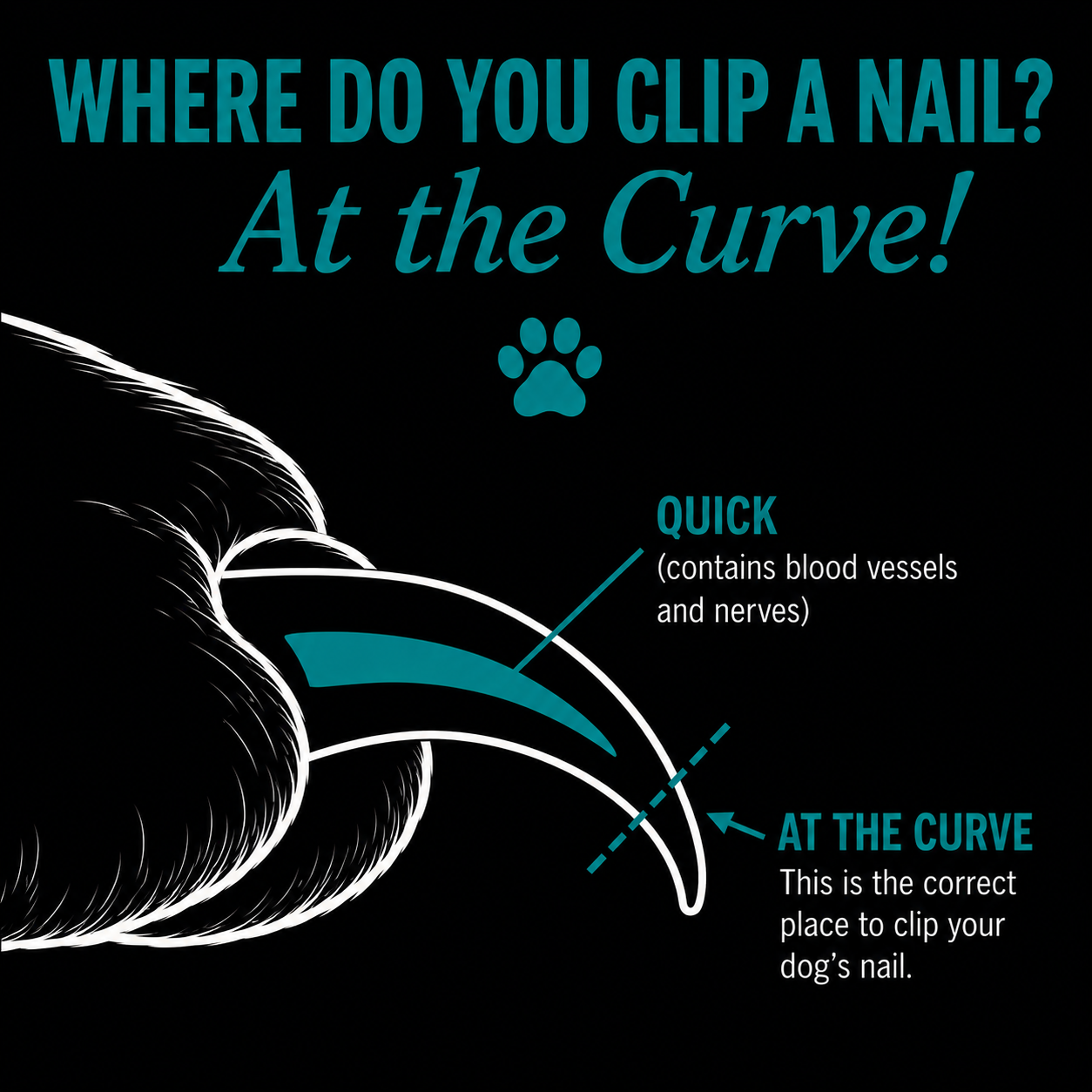
Did you notice how ‘to the quick’ is not a part of that answer? I’ve never taken a test with a question about clipping nails where ‘to the quick’ was the answer. The quick is actually a variable in every nail trim but not actually the deciding factor or always the same length within nails. Look at a normal dog nail from the side. The nail comes out from the toe and then begins curving downward.
That curve gives you a practical visual landmark.
You are generally removing the excess nail extending beyond that natural curve, not attempting to chop the nail all the way back toward the toe.
This is especially helpful for owners who have absolutely no idea what they're looking at and are terrified they're going to amputate something.
You're trimming a nail. We're not performing surgery.
With clear or light-colored nails, you have an advantage because you can usually see the pink quick inside the nail. Stay safely in front of it.
Black nails can require a little more attention because you can't see through them from the outside. You CAN clip back at smaller amounts IF the pet is tolerable of nail trims and will stand or sit that long. If that very first nail at the curve unexpectedly has you reaching for the Quick Stop, take the hint. Your pup probably has longer quicks than average. Go further forward just a little on the remaining nails instead of repeating the same surprise.
If your pup is tolerating multiple short clips you can watch the center from the underside as it begins changing as you get closer to the quick inside the nail. When you're approaching the quick, stop.
It’s also important to note that quicks occur because they aren’t sitting still or liking this part of the process and moving around a lot while the nails are being trimmed. It happens. Often. Which is why we will also go over some ways to help desensitize pups to nail trims and feet handling at home in this article.
So What Is the Quick?
The quick is the living tissue inside the nail containing blood vessels and nerves.
That's why cutting into it stings for a second and it bleeds.
It's also why we try not to cut it.
But I want to clear up something that has become ridiculously dramatized over the years.
Quicking a dog is not equivalent to cutting off their toe.
Does it hurt a bit?
Yes. And every pup reacts differently. Some scream just cause their foot is being held or BECAUSE their nails are being trimmed before we even do anything without being quicked and many don’t even react in the slightest when they ARE accidentally quicked.
There's a sharp sting, and it can certainly be unpleasant but dogs react briefly if at all and recover just fine before you’ve even made it to the next nail if things are occurring in a more relaxed manner (it’s not the quick they remember and anticipate in most cases, it’s the other things occurring during a nail trim that scares them, i.e. being forced).
Every groomer or bather who has trimmed thousands upon thousands of nails has quicked nails. Veterinarians quick nails. Veterinary technicians quick nails. Owners quick nails. The only way to not ever quick a nail is not ever trim them. But that would be far more painful to our beloved companions if we all just stopped trimming nails.
Dogs move. Nails can be difficult to read. Black nails don't come with little signs inside saying STOP HERE. Dogs aren't exactly known for patiently standing there while we spend fifteen minutes analyzing one black nail much less each one.
Nobody should intentionally quick a nail, but accidentally nicking one is not automatically some catastrophic event that will emotionally scar a dog for the remainder of its natural life.
What causes many serious nail-trimming problems is everything surrounding the experience.
Blood Does Not Always Mean the Groomer Just Quicked the Nail
Here's another nail-trimming misconception worth clearing up.
You see blood, therefore somebody must have cut deeply into the quick.
Not necessarily.
Sometimes a nail can be trimmed extremely close to the quick without actually cutting into it. There may be only a paper-thin layer of nail left covering the end of that living tissue.
The dog gets off the grooming table. Nothing is bleeding.
The dog walks around the salon. Still nothing.
Then they scratch at something, put pressure on that nail, drag it across the floor or launch themselves out the door at approximately 700 miles per hour because MOM IS HERE.
Suddenly there's blood.
That doesn't necessarily mean the nail was actively quicked during the nail trim.
That tiny remaining layer of nail can wear or scrape away afterward and expose the very end of the quick. Feet also take a fair amount of abuse simply because dogs walk on them. Pressure and activity can cause a minor nail injury to begin bleeding again after it initially appeared perfectly fine.
This is also why you can sometimes pick up a perfectly non-bleeding dog from the groomer and discover a little blood later.
Nobody necessarily committed a toenail massacre while you weren't looking.
Why Can Such a Tiny Nail Injury Look Like So Much Blood?
Nails have a blood supply.
That means even a very small injury to the quick can produce an impressive-looking amount of blood, especially once a dog starts walking around and distributing it everywhere.
One drop becomes a paw print.
That paw print becomes six paw prints.
Then the dog steps on your leg, walks across the floor and shakes a foot.
Congratulations. Your house now looks like somebody needs to call CSI, and we're talking about an injury that may amount to a tiny scrape at the end of one toenail.
There are also reasons one dog may bleed more readily than another.
Stress and excitement can temporarily raise a dog's blood pressure. And what might possibly be exciting or stressful to a dog about having someone mess with their feet?
Exactly.
Some dogs also have underlying medical conditions associated with high blood pressure, while other medical problems can interfere with normal clotting and make bleeding from even a relatively minor injury harder to stop.
This doesn't mean excessive or persistent bleeding should simply be dismissed as "just a nail." If a tiny nail injury is bleeding unusually heavily, repeatedly starts bleeding again or won't stop with appropriate styptic powder and sustained pressure, that deserves attention. Unexplained excessive bleeding can sometimes be an indication that something else is going on medically.
But the amount of blood you SEE is not necessarily a reliable measurement of how severe the original nail injury was. Nails can bleed a lot. Much like very minor scrapes on ears and those ‘the dog licked the scissors’ moments where a papercut somehow looks like a body part is missing.
A tiny nick to the very end of the quick generally produces a quick sting at the moment it happens. That's it. The dog isn't continuing to experience the level of agony you might imagine from looking at blood tracked halfway across the kitchen.
Blood is dramatic.
Dogs running around on bleeding feet make it considerably more dramatic.
And toenails are remarkably good at turning a very small incident into what appears to be a major crime scene.
Being Quicked and Being Terrified of Nail Trims Are Not the Same Thing
Many of us have worked with plenty of dogs that were absolutely convinced nail trimming meant certain death. Some had probably been quicked before. So have thousands of dogs that stand or sit perfectly fine for nail trims.
The bigger issue and trauma is often what happens when the dog becomes frightened or uncomfortable and people decide the solution is to overpower them and force the procedure anyway.
Imagine being afraid of something, trying desperately to get away from it and then having several people grab you, pin you down and continue doing the thing you're terrified of while you struggle.
THAT is an excellent way to teach an animal that nail trimming is horrifying.
Once a dog learns that touching their feet means they're about to lose control of their body and be forced through something frightening, you've created a much larger problem than one accidentally quicked nail.
There are obviously situations where a dog's nails desperately need attention and handling them isn't optional. But routinely wrestling a frightened puppy through nail trims is not how I would teach that puppy to tolerate nail care for the next 10 or 15 years.
One thing I do suggest for pups who NEED those nail trims but we’re working on making it a more positive experience? Do those at your vet. Have them be the bad guy and let the groomer clip or dremel a nail or two during each groom or whatever they are tolerating so they don’t associate that forced unpleasantness with the groomers and the grooming establishment. Don’t do a forced nail trim at the vet and a grooming on the same day. This often gives us the BEST shot of eventually working your pup around to cooperating and trusting us for nail trims without the forcing the issue that is ACTUALLY what creates the fear. Not being quicked.
If you're starting with a puppy, you have a huge advantage though these next sections are recommended for ALL dogs who don’t love their feet touched.
Use it please.
Start Playing With Your Dogs Feet
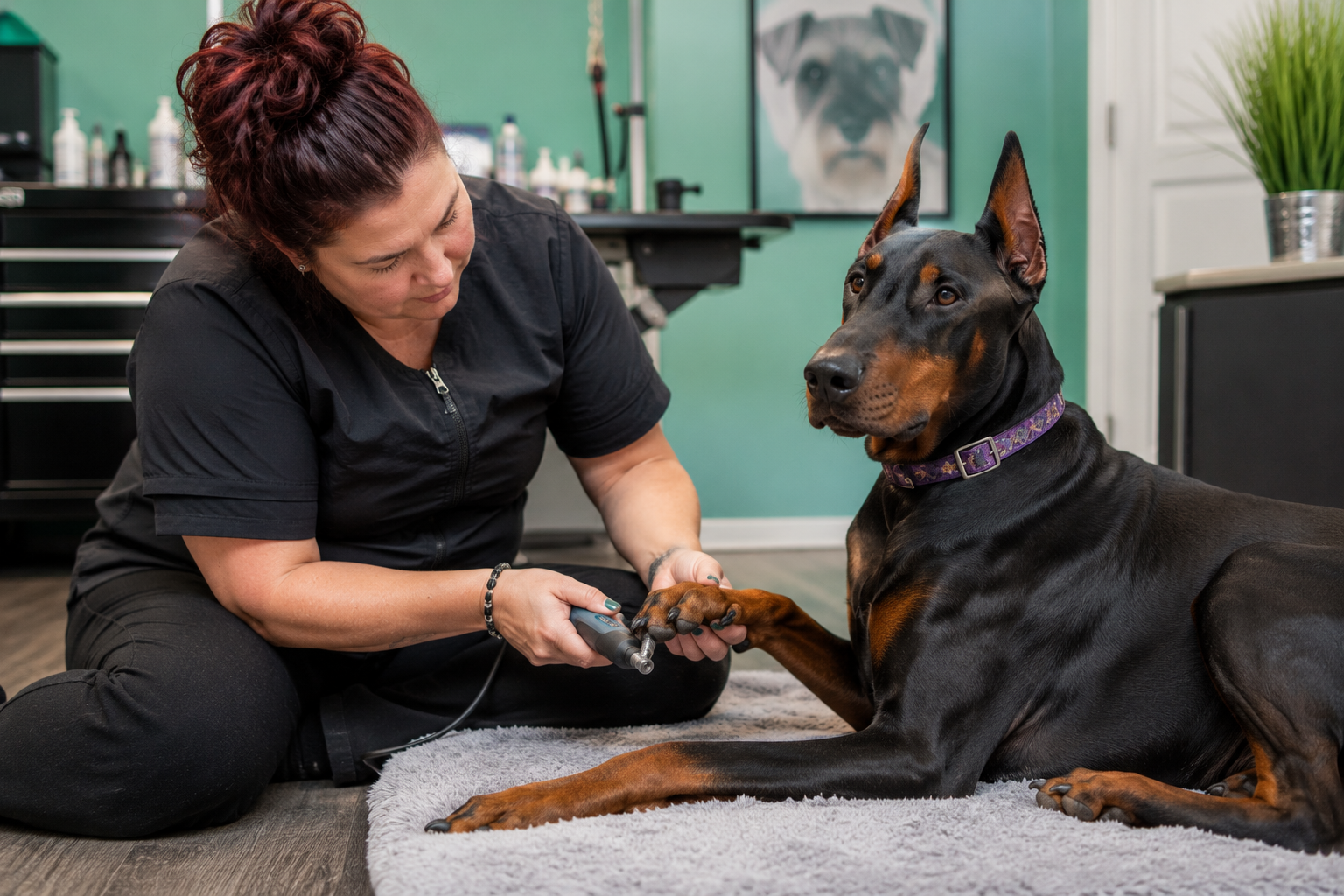
One of the easiest things you can do at home is simply teach your puppy that having their feet handled isn't a big deal. Touch the paws. Hold one for a second. touch individual toes. Gently press on a nail. Rub between the toes. Then let go.
That's it.
Not every interaction with your dogs feet needs to end with nail clippers appearing.
In fact, we specifically WANT dogs to experience people handling their feet when absolutely nothing happens afterward.
You're teaching:
Someone touched my foot.
The world did not end.
Do it casually while you're sitting together. Keep sessions ridiculously short at first. You aren't trying to prove that you can hold onto the paw longer while the dog pulls it away. We're not having a battle of wills with a 8 week old puppy or a 14 year old senior dog over a toenail.
Once paw handling becomes boring, introduce the nail clippers without immediately launching into a complete nail trim.
Let the puppy see them.
Touch a paw while you're holding them.
Touch the clippers gently against a nail without cutting it.
Clip ONE nail if the pet is comfortable.
You don't necessarily have to finish every foot because you've started.
One successful nail is more useful than finishing all of them after the dog has become frightened, frantic and determined to never let another human being touch its feet again. It’s a negative experience when we turn it into one consistently. It’s a no big deal experience when we work to make it no big deal.
Getting Your Dog Used to a Nail Grinder Without Starting With the Nail Grinder
Some dogs do much better with a Dremel or other electric nail grinder than they do with traditional nail clippers. It’s getting the nails to a healthy length when we can that matters, not which tool we use to do it. It’s usually best to let them pick if they have a preference rather than trying to force them through the process and make them hate nail trims.
If an owner tells me their dog absolutely hates nail trims, one of the first things I'll do is simply show them both the nail clippers and the Dremel separately before I ever touch a foot. It's amazing how many dogs immediately tell me which one they don't like and associate with negatively on sight. Sometimes they'll barely react to one tool but become noticeably anxious the moment they see or hear the other.
That tells me a lot.
Whenever it's safe and practical, I'll often start with the tool they're least concerned about. In many cases, it's the one they haven't had unpleasant experiences with in the past. My goal isn't to prove one tool is better than the other. My goal is to get the nails to a healthy length while making the experience as positive as possible in a way that works the best for THEM long term.
Some dogs hear that nail grinder thing turn on and immediately decide they're leaving the country.
The sound is part of it, but vibration is a big part too. A grinder touching the nail creates a strange vibration that travels through the nail and into the toe. If a puppy has never experienced anything remotely like that before, turning on a loud grinder and immediately sticking it against their toenail is a pretty big first introduction. With older dogs this can be especially uncomfortable for old arthritic bones and joints with all that vibration.
And then there’s the smell which is MUCH stronger to them than to us and can induce panic in some pups.
This is where an electric toothbrush can come in handy if your pup is gonna tolerate the dremel in the future or your groomer has informed you that your pup does not like dremels but you REALLY want those suckers dremeled.
An electric toothbrush isn't going to feel exactly like a nail grinder, nor is that the point. What it does give you is a much smaller, less intimidating vibrating object that you can use to introduce the general idea of vibration.
Start by simply turning it on nearby.
If your puppy doesn't care, great.
Then you can touch the handle against the body for a second. Eventually work your way down the legs and toward the feet. When your puppy is comfortable with that, briefly touch the vibrating handle against a toe or nail.
Again, we're not trying to hold the puppy hostage until they surrender.
A second is fine.
Then two seconds.
Then maybe a few more.
Once vibration around the feet has become completely uninteresting, introducing an actual nail grinder is much less of a jump.
You can use the same gradual process with the grinder itself. Turn it on without touching the dog. Let that become boring. Bring it closer. Touch the body of the tool against the foot without grinding anything.
Eventually, briefly touch the grinder to one nail.
And stop.
You do not have to Dremel 18 nails during the first lesson just because the puppy let you do one.
When actually grinding nails, use short contacts rather than holding the grinder continuously against one spot. Friction creates heat, and heat hurts. Also if you are concerned about quacking your pup? Be aware that dremels frequently come into contact with the quicks, it’s not less often than a nail clipper. The difference is that the heat and friction from the grinder usually cauterizes the nail and prevents further bleeding unless it’s much further into the quick so it’s likely to go unnoticed.
Also pay attention to long hair around the feet. Hair wrapped around a rapidly spinning Dremel is an entirely different problem and can be FAR more painful than a quicked nail that nobody needs.
Keeping Nails Smooth After Grooming and Between Trims
You may occasionally notice that your dog's nails aren't quite as smooth as you'd like after a nail trim. Other times, they may have felt perfectly smooth at first, only to develop a tiny rough edge over the next several days.
That's completely normal.
Dogs don't spend their days sitting in bubble wrap. They walk on sidewalks, scratch at the back door, dig in the yard, jump off the couch, wrestle with their toys and generally use their feet exactly the way dogs are supposed to. A tiny rough edge can develop simply through normal daily activity.
Fortunately, this is one of the easiest parts of nail care to maintain at home.
A regular human emery board or nail file is all you need.
Hold your dog's paw the same way you would if you were looking at the nails. Support the toe with one hand and use the emery board with the other. Using light pressure, gently file only the rough edge until it feels smooth. You don't need to bear down or spend several minutes on each nail. A few gentle passes are often all it takes.
Every few strokes, stop and feel the nail with your fingertip. If it no longer catches your skin or snags a blanket, you're finished.
Remember, you're not trying to shorten the nail or perform another nail trim. You're simply smoothing the little rough spot that's bothering you.
If your dog has had enough after one or two nails, that's perfectly fine. Touch up another one later. There's no rule that says every nail has to be clipped or filed in one sitting.
One quick note for cat owners: this works beautifully for most dogs, but cat claws are built differently. Because cats naturally shed the outer layers of their claws, an emery board or dremel often causes those layers to fray and shred instead of smoothing them. For cats, simply trimming the sharp hooked tip is usually the better option.
Keeping an inexpensive emery board with your pet supplies is one of those little things you'll probably use far more often than you expected. And you won’t need to stress out your pet and the folks trying to keep those nails at healthy lengths trying to get everything to your liking in one shot every nail trim.
Cat Nails Need Attention Too
Cat nail trimming is generally pretty simple once you know what you're looking at.
Gently press the toe so the claw extends. On most cats, the claw is translucent enough that you can clearly see the pink quick running through it.
You aren't trying to cut anywhere near that.
You're simply clipping off the sharp curved hook at the end.
Cat claws are usually much easier to read than black dog nails, which is nice because the cat may provide plenty of other challenges to keep things interesting.
Dewclaw-type inner claws and the claws on older cats deserve particular attention.
Cats normally shed the outer layers of their claws as they scratch. You may have found those little hollow-looking claw sheaths around a scratching post and wondered whether your cat somehow lost an entire claw.
They didn't.
That's normal.
As cats age, however, they may become less active, scratch less or have more difficulty maintaining their own claws. The claws can become thicker and continue growing until they curl toward the paw pad.
Some cat nails can grow directly into the pad.
That's painful and can create a wound and infection.
Senior cats should have their feet checked regularly even if nobody has ever needed to trim their nails before.

Why Did They Say My Dog Has Long Quicks?
Here's another thing we see often. Someone finally decides their dog's nails are way too long and wants them cut extremely short in one appointment.
Except we can't necessarily do that.
Remember that the quick is living tissue inside the nail.
As a dog's nails remain long, the quick can extend farther down into the nail. That means there may simply not be enough dead nail available to safely remove everything you would LIKE removed at once. You can't just decide where the nail should end and cut there.
This is where regular trims become important.
If nails and quicks have become excessively long, trimming them approximately every two weeks can gradually help work the nails back as the quicks move back into a more natural and preferred length.
Each time, you're removing the safe excess and getting closer to the quick without intentionally cutting into it. Over time, the quick can gradually recede, allowing the nail to be shortened farther. This is not an overnight process. And how quickly it happens varies from dog to dog.
The goal isn't to chase the quick backward by repeatedly cutting into it. The goal is frequent, conservative nail trimming that keeps removing the excess as the nail and quick adjust.
If you have a dog with extremely long nails, think gradual improvement rather than trying to fix six months of nail growth in six minutes.
One Exception to the Rule
Throughout this article, we've talked about avoiding the quick whenever possible during routine nail trims.
There is one exception that may be worth discussing with your veterinarian.
If your dog is already scheduled to be under general anesthesia for a dental cleaning or another surgical procedure, ask your veterinarian whether intentionally shortening the nails farther than would normally be recommended on an awake dog would be beneficial.
Because your dog is already under anesthesia, they won't experience the brief sting associated with exposing the quick, and there is no struggling or fear associated with the process. For dogs with chronically overgrown nails and excessively long quicks, this can be an excellent opportunity to reset the nails to a much healthier length, allowing them to grow back into a healthier, more manageable position that's much easier to maintain with regular nail trims.
While you're having that conversation, it's also a good opportunity to ask whether removing any pesky dewclaws that may be at risk of being torn off in the future would be beneficial while your dog is already under anesthesia. If your veterinarian feels it's appropriate, addressing both during the same procedure may help prevent problems down the road.
Okay, You Hit the Quick. Now What?
First, this is why we recommend having Quick Stop or another styptic powder available BEFORE you start trimming nails and in general for first aid for torn or bleeding nails. Not after.
Before.
Because naturally, the one time you don't have it will be the time somebody jerks their foot at exactly the wrong second. Styptic powder helps stop bleeding by promoting clotting at the cut surface. Put some directly onto the bleeding nail and apply firm pressure. Don't dab at it or check it every three seconds to see if it's still bleeding.
Pressure needs time to work. Hold it there.
Most accidentally quicked nails look considerably more dramatic than they actually are because even a relatively small amount of blood can quickly get smeared across a paw, your floor, your clothes and possibly every surface your dog can reach while you're trying to catch them.
Once you've stopped the bleeding, keep the dog reasonably quiet for a little while so they don't immediately knock the clot loose running around the house.
What If You Don't Have Quick Stop?
Of course, emergencies rarely happen when you've thoughtfully assembled every supply you could possibly need.
If you accidentally quick a nail and don't have styptic powder, cornstarch or flour can be used temporarily to help control the bleeding. Put some into a small container or your palm, press the nail into it and then apply steady pressure.
The pressure is important.
A clean bar of soap can also be used in a pinch by gently pressing the bleeding nail into the softened soap.
These are emergency substitutes, not reasons to permanently replace styptic powder if you're regularly trimming nails at home.
Quick Stop is inexpensive.
Buy some.
Put it with the nail clippers and/or dremel.
Then you don't have to tear through your kitchen cabinets with a bleeding dog under your arm trying to remember whether I said cornstarch or baking soda.
It was Cornstarch.
When a Bleeding Nail Is More Than Just a Quicked Nail
There is a big difference between accidentally clipping into the quick and having a nail tear, split or partially rip off.
Dogs can catch nails on carpets, blankets, furniture, fencing and plenty of other things.
Dewclaws are especially vulnerable because of where they sit on the leg.
A torn dewclaw can bleed A LOT.
Again, don't panic just because there's blood everywhere. Nails are vascular, and blood gets spread around quickly.
Your first job is controlling the bleeding.
Apply styptic powder if you have it and use firm pressure with clean gauze or another clean absorbent material.
If the nail is partially attached, don't start yanking on it because it looks like it should come off.
That remaining piece may still be attached to living tissue and pulling it can be extremely painful and cause additional damage.
If bleeding won't stop with sustained pressure, the nail has torn significantly, the nail is dangling, the nail bed is exposed, your pet is in substantial pain or you're dealing with a deep injury around the toe, it's time to contact your veterinarian.
Broken nails can sometimes require removal of the damaged portion, pain management and treatment of the exposed nail bed.
The same applies when an overgrown nail has penetrated a paw pad.
Don't simply clip the nail out of the pad and assume the problem is finished.
That nail has created a puncture wound.
The area may need veterinary attention, particularly if there is swelling, discharge, significant pain, odor or any other sign of infection. Your groomer will usually remember to inform you if there was an embedded nail during their grooming or nail trim appointment so you can properly monitor the area.
How Often Should Nails Actually Be Trimmed?
There isn't one perfect schedule for every dog.
Some dogs naturally wear their nails down considerably by walking on hard surfaces. Others barely wear them at all. Dewclaws aren't hitting the ground, so don't assume they're fine because the other nails look good.
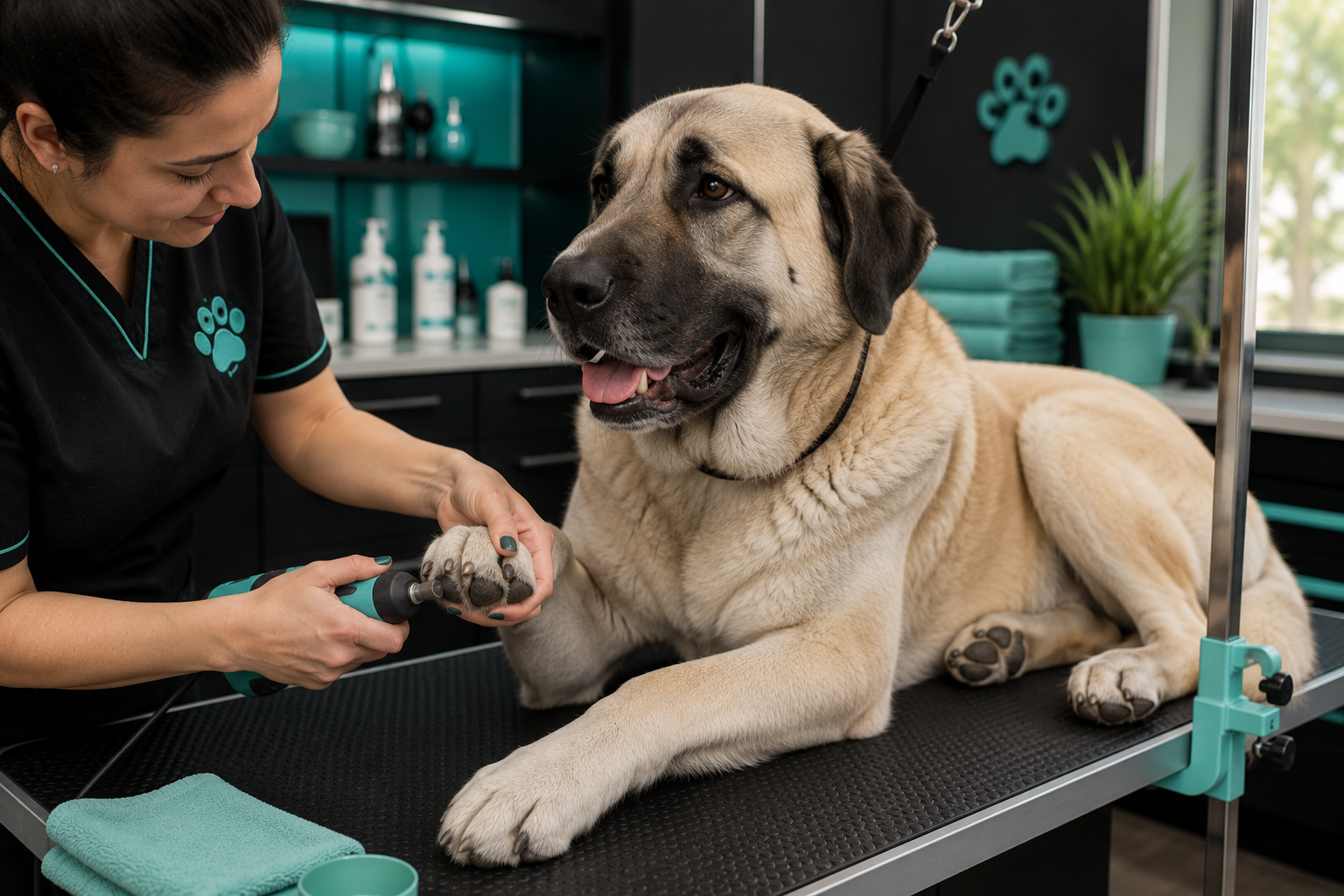
For many dogs, checking nails every few weeks is a good habit. If you're trying to gradually shorten excessively long nails and encourage long quicks to recede, approximately every two weeks is a reasonable schedule.
The easiest way to avoid having to fix severely overgrown nails is simply not letting them become severely overgrown in the first place. If your dog sounds like a tiny tap dancer walking across the kitchen floor, take a look at their feet. If the nails are touching the ground it’s probably time for a visit to the groomer.
Nail Care Doesn't Have to Become a Wrestling Match
Nail trimming is necessary.
Turning every nail trim into an event worthy of professional wrestling is not.
Start handling feet, preferably when your dog is young but it’s never too late.
Teach puppies that touching their toes is normal.
Introduce clippers and grinders gradually.
Use an electric toothbrush if vibration is the scary part.
Use an emery board to smooth those ridiculous little razor blades just after and in between trims.
Keep styptic powder nearby.
Learn what the quick looks like.
And remember the easiest visual rule when you're wondering where you're supposed to trim:
Look for the curve.
That's generally the excess nail you're trying to remove.
If your dog already has a serious fear of nail trimming, don't assume the solution is simply holding them harder. Sometimes slowing down and rebuilding their tolerance to having their feet handled will get you much farther than winning another wrestling match.
Because ultimately, nail trimming should be routine maintenance.
Not a traumatic life event for the dog, the owner, the groomer and three innocent bystanders.
Final Thoughts
Hopefully, you've come away with a better understanding of what really goes into trimming nails and why it isn't always as simple as it might appear. Hopefully, you now understand that accidentally quicking a nail is not the end of the world, not a major injury and certainly not automatic proof that someone was careless or negligent. Hopefully, you'll also understand why your dog's nails may not always be quite as short, smooth or perfectly rounded as you were hoping after a single appointment, and why that's sometimes in your dog's best interest.
Most of all, I hope you'll be a little kinder to the person holding the nail clippers. Whether that's your groomer, veterinarian, veterinary technician, bather or even yourself, we're all trying to do what's best for a living, moving animal that doesn't always feel like cooperating or understanding of the fact we're trying to help them. Because one day, the person trimming your pup's nails might just be you.
Whether you're using a mobile groomer, visiting a traditional grooming salon, having your veterinarian handle those toes or tackling nail trims at home, may all your future nail trims be much smoother sailing, your quicks remain untouched and your Quick Stop stay safely in the container where it belongs.
Recent Posts