Why Does Grooming Take So Long?
Why Does Grooming Take So Long?
The truth is, there isn’t one answer to this question. There are multiple factors, situations and combinations that can affect how long grooming takes. In this article, we’re going to help you understand some of them so you can stress out your groomer AND your pup a little less during the grooming process.
Grooming times are estimates. Good estimates, usually, because we do this all day every day. But we are also working on living animals who have absolutely no idea that your groomer has allotted two hours for this appointment and frankly do not care.
Time, Stress and Safety
The second you start pressuring your groomer about time, you’ve introduced stress into the groom. Your groomer now knows that you’re waiting, getting impatient or need the dog finished NOW, or sooner than they expected, and may start trying to work faster. Your dog picks up on the groomer’s stress or hurried movements and frequently becomes stressed right along with them. And shows it.
Now, instead of calmly grooming a relatively cooperative dog, your groomer is trying to work faster on a dog who has started moving around, fighting the process, sitting down, pulling feet away or otherwise becoming considerably less cooperative. All while using very sharp equipment that can cause serious injuries with one sudden movement, including scissors and clipper blades. This is not an ideal combination.
Grooming requires concentration, calm, controlled movements and deliberate positioning of both the dog and the tools. There are areas where the difference between perfectly safe and an injury can quite literally be one unexpected and fast movement. Professional grooming standards put a huge emphasis on safe handling, behavior management and pet safety for exactly that reason. These aren’t side issues to grooming. They’re part of doing the job correctly.
If you genuinely have a time constraint, tell your groomer when you make the appointment. We can usually tell you whether it’s realistic and plan accordingly. Calling halfway through and suddenly announcing that you need your dog in thirty minutes doesn’t create thirty extra minutes in our day. Neither does informing us at drop off you need your pup back in an hour and a half when we were planning on 2 - 3, when the entire day may already be planned down to the minute. It creates a stressed groomer, usually a stressed dog and exactly the situation we DON’T want when sharp objects are involved.
If you have somewhere you absolutely have to be at noon, that information was considerably more useful to us when you made the appointment than it is at 10:30/11:00.
No Two Dogs, Groomers, Shops Or Days Are Exactly The Same
No two dogs, no two groomers, no two shops and no two days are exactly the same.
Sometimes even a dog who is normally a perfect angel can decide they aren’t feeling well, pick up on stress from home or their groomer, dislike the weather, develop arthritis, need a dental or simply not be into it that day. Any of those things can make the groom take longer than usual.
And sometimes there is absolutely nothing you can point to. They’re just having a bad day and aren’t into it.
Dogs aren’t machines. Neither are groomers. A dog who normally stands beautifully may decide today that every time you pick up his front foot, he needs it back IMMEDIATELY. A dog who normally doesn’t care about the dryer may decide today that it’s horrible. Something that normally takes five minutes can suddenly take fifteen.
Age changes things too. A dog who could stand comfortably through an entire groom when he was five may need to sit more at twelve. He may not tolerate having a leg held in the same position for as long. He may need little breaks during the process. The groomer can work around those things, but working around them takes time.
The opposite happens too. Puppies and inexperienced dogs may need extra time simply because they haven’t figured out the program yet. Standing still on a table while somebody handles your feet, points a dryer at you, runs vibrating clippers over your body and expects you to hold your head still for scissors is not something dogs are born knowing how to do. They learn through repetition and experience.
Some learn quickly. Some spend the first several appointments convinced that having their front legs brushed is a violation of their constitutional rights.
Sometimes It’s The Groomer
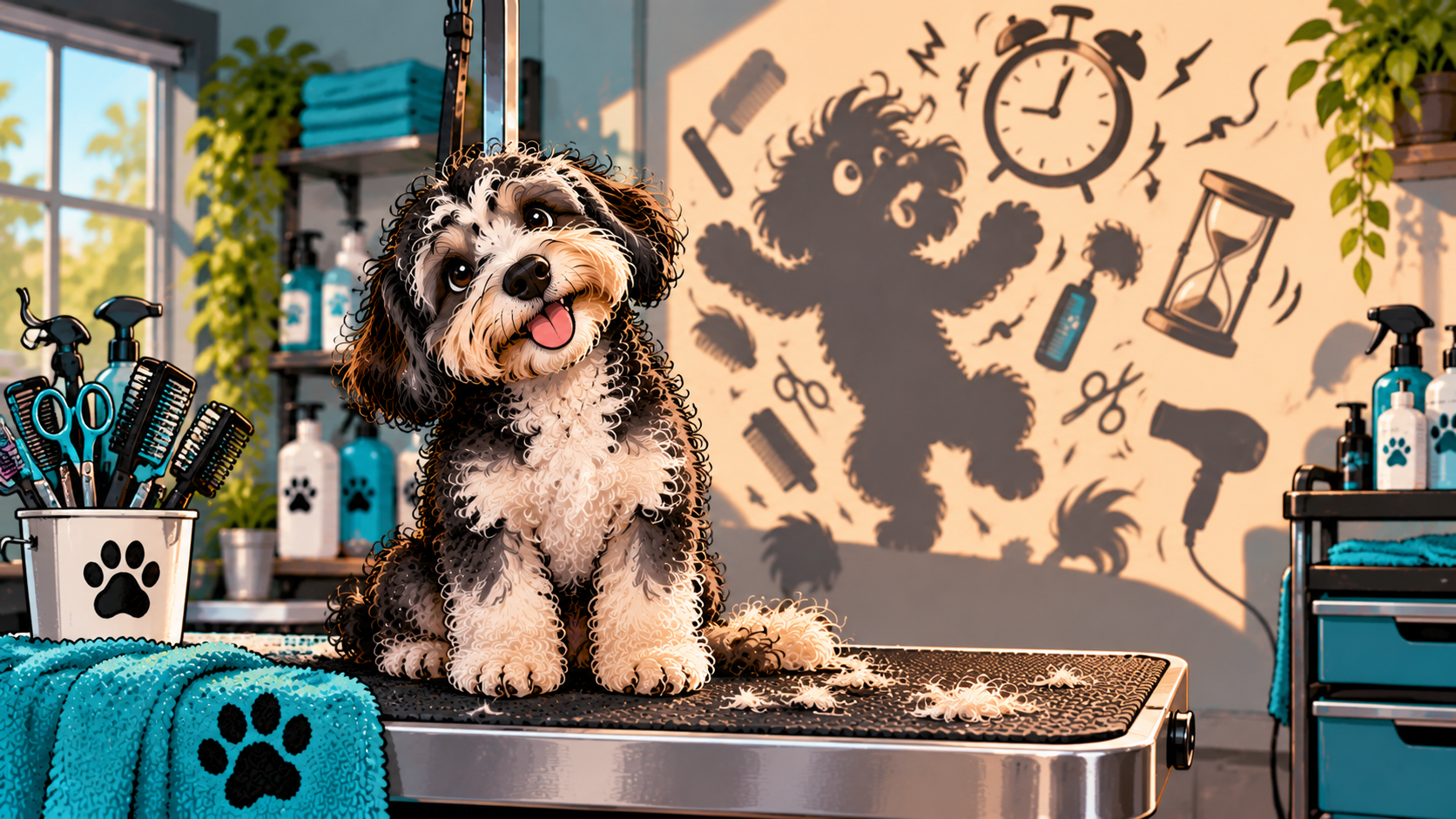
Sometimes your groomer isn’t feeling well or has physical injuries or health issues you aren’t aware of, leading to longer grooming times. Grooming is an unbelievably physical job, and groomers are a tough bunch who often push through things that might keep others in bed.
That does, however, mean we won’t win any speed races when our backs are injured, our wrists are popping, our shoulders are having a tendonitis party, we have a migraine or a cold, or that 100 pound dog who didn’t want to be dried yesterday has messed up our body for the rest of the week.
Grooming involves standing most of the day while lifting dogs, bending over tubs, controlling moving animals, holding legs, brushing, drying, clipping, scissor work and other repetitive motion that causes frequent injuries and things considered disabilities. Then we wake up the next morning, discover an entirely new body part hurts like the dickens and go do it again. Sometimes your groomer is perfectly capable of doing their job safely, but they’re simply moving a little slower that day.
There are also differences between groomers. One groomer may be extremely fast at doing a particular dog, cut or trim because they do it constantly and/or have developed a routine and trust with that dog. Another may take longer because of the way they work or their body has different restrictions. Someone may be faster with clippers but spend more time finishing with scissors. Groomers develop their own routines and techniques over years behind the table. They also deal with different physical and mental limitations. No two groomers are the same.
So “my other groomer did him in an hour” doesn’t really tell us how long THIS groom will take. Neither does, “You did him in an hour and thirty minutes last time.” And sometimes I get every green light on the way to work. Neither one is a schedule I would recommend planning your entire day around.
Different Shops Work Completely Differently
Another thing that affects grooming time is the business model.
Some shops book a large number of dogs at the same time in order to keep their schedules full. These shops may take longer, with an average turnaround time of two to five hours. They may also be able to charge a little less because the spots are consistently filled.
In this type of shop, several dogs may be moving through different stages at once. One is bathing while another is drying, another is being brushed and another is on the grooming table. Your dog isn’t necessarily being actively worked on every single minute they’re there but is ready when the groomer gets there hopefully and has probably spent much less time in the kennel than you think.
Then there are one on one salons and mobile groomers, where the entire business is structured around working straight through one dog at a time while the next may be being bathed and prepped. Obviously, the amount of time the dog spends there is going to look completely different and often much shorter.
Shops with this model may use strict scheduling, with groomers booked for only four to seven dogs throughout the day in order to get the dogs finished faster. These shops need to charge a little more and may also charge fees for missed appointments.
Remember, groomers mostly work on commission, so they don’t get paid if they aren’t grooming dogs and neither does the shop. Holding a two hour appointment for someone who doesn’t show up can literally mean losing two hours of income while sitting around, twiddling your thumbs and thinking about the 400 other things you could be doing on your personal unpaid free time instead of sitting around waiting to go back to work.
Being late matters in this type of scheduling too. Fifteen minutes may not sound like much, but that fifteen minutes doesn’t disappear just because you arrived. The bath starts late, the drying starts late and the haircut starts late. Meanwhile, the next client who DID arrive on time is coming through the door.
Do that a few times during the day and by three o’clock your groomer is looking at the clock like it has personally betrayed them and may have ALSO had to deal with the stress of other clients regarding time issues due to that snowball rolling downhill and getting bigger by the minute.
Some shops may work on a first come, first served, walk in only basis, with no appointments other than cats or special needs dogs. This means you can arrive at nine o’clock and be number twenty on the list or number five depending on the day. That’s the price you chose for the convenience of being able to walk in on whatever day and reasonable time that works for you on the fly.
None of these models automatically makes one shop better than another. They’re simply different ways of running a grooming business and comparing turnaround times without considering HOW the shops operate doesn’t tell you much.
But you do get to choose which method you prefer. Want fast service? Pay more and pick up and drop off on time. Want more convenient booking and a lower cost? Be ready to wait. There really isn’t a way to combine super-fast service, any day you want, any drop off time you want, super cheap pricing, precise Asian fusion or long coat scissoring and extensive de-matting into ONE fast and easy booking model.
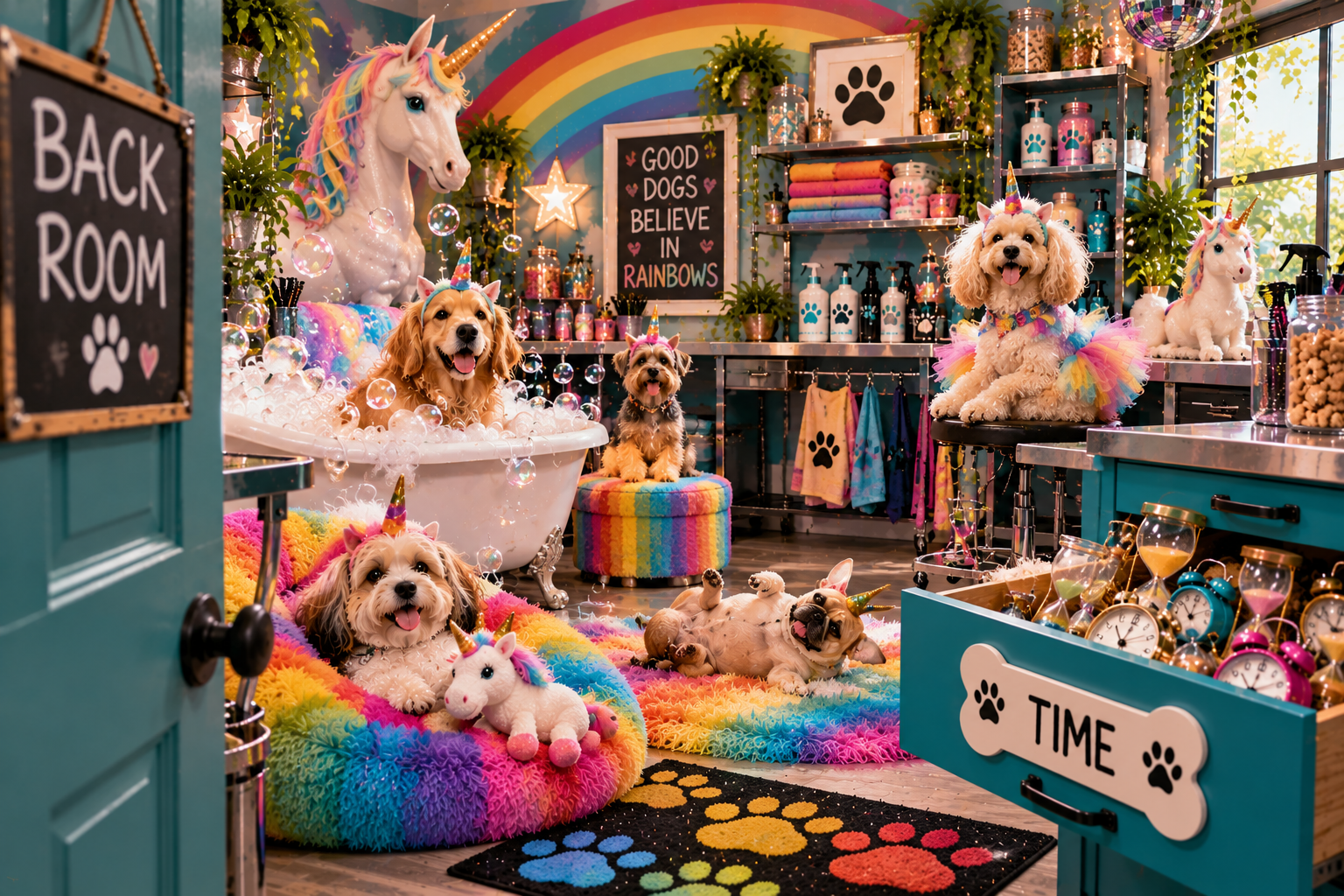
If you find the magical shop that does all of those things at once, please check the back room for rainbows and unicorns and send us a pic! Choose the option that works best for you, but don’t pressure a shop to change its entire system just for you.
The Haircut Is Only Part Of The Groom
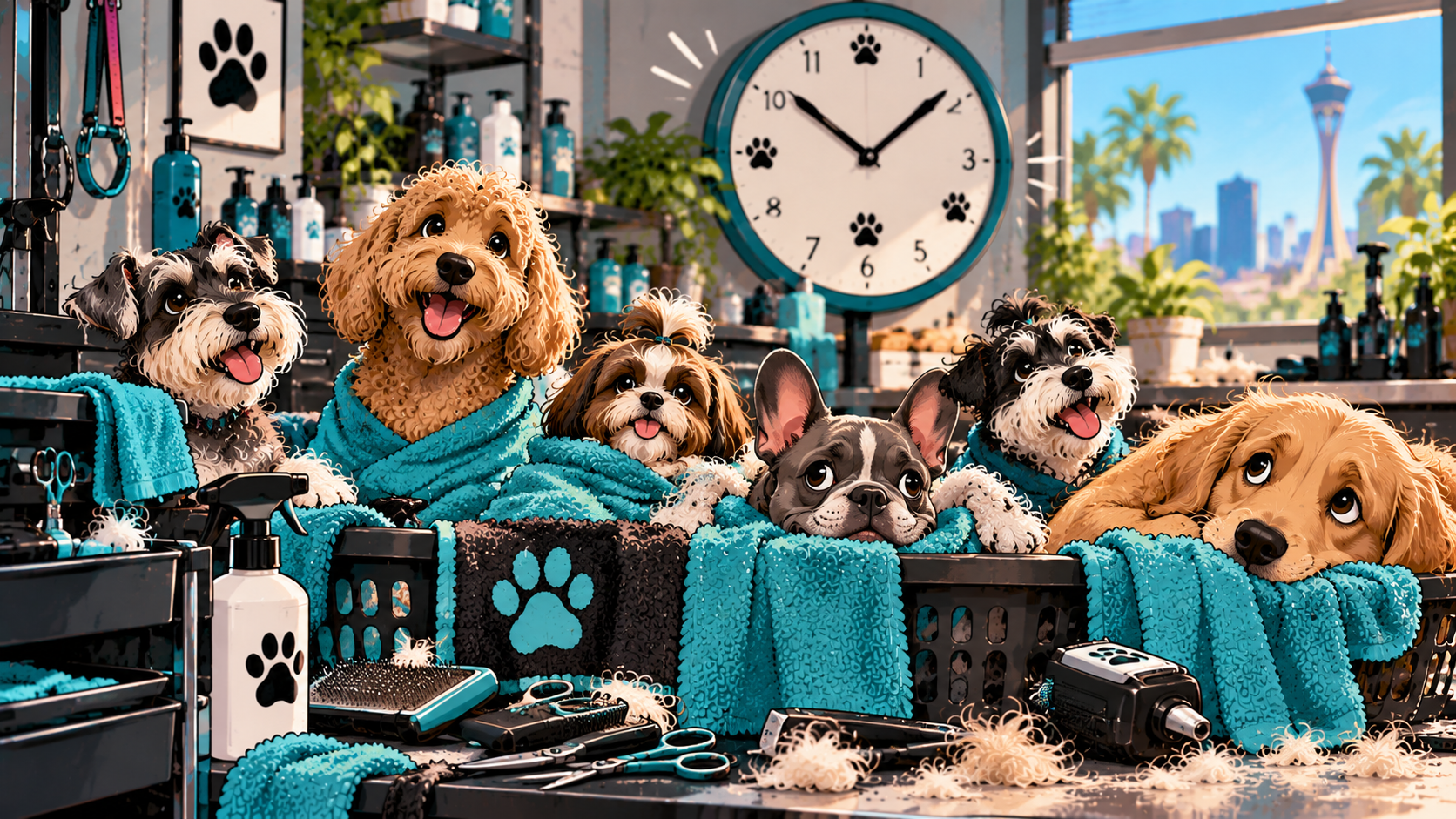
The way a grooming shop bathes and brushes is completely different and much more thorough than the way a dog may be bathed at home or somewhere else. This takes more time. This is probably one of the biggest things people underestimate because the haircut is what you actually SEE when you pick your dog up. A good haircut starts long before the scissors or clippers come out.
The coat has to be thoroughly clean, fluffed, straight and dry with no residue or product weighing down the coat or over-harshing it. Shampoo needs to get through the coat rather than simply across the top of it and over the ENTIRE dog from the tip of their nose to the tip of their tail and the pads of their feet and everything in between. Most decent shops wash at least twice. Every last bit needs to be THOROUGHLY rinsed and then again to prevent itchy dry skin or other issues from leftover shampoo. We need to protect the ears from water while ensuring the inside is still clean, the eyes from soap and scrub those booties, faces and feet thoroughly. Eye boogers are not a snap removal. Depending on the coat, there may be conditioning, de-shedding or additional coat work involved. Medicated and special shampoos often need to sit for 10 minutes. Then all that water has to come back OUT.
And drying a Chihuahua is obviously not the same project as drying an 80-pound doodle.
Coat density matters. Length matters. Undercoat matters. The dog’s tolerance of the dryer matters. A dog who stands beautifully for a high-velocity dryer can be dried much faster than a dog who spends the entire process attempting to fight an invisible hurricane.
And the coat actually has to be dry. If a thick coat takes another twenty minutes to dry properly, we cannot get those twenty minutes back by deciding 80% dry is probably close enough. Proper coat preparation is what allows us to produce the haircut you’re expecting in the first place. Coats left wet and not properly dried near the skin can also contribute to hot spots. Not all dogs tolerate max velocity and the process can take longer.
Then the coat has to be brushed, combed and properly prepared for whatever haircut we’re doing. It’s important to keep in mind that groomers generally account for preparation brushing, usually about twenty minutes to fluff the coat, not for catching up on the six to twelve weeks of brushing that may not have happened between appointments. THAT is a whole different thing and catching up on missed brushing is not included in basic service times. So if we agree (albeit often with an extra charge) to extra brushing then it takes more time. If not……. Be prepared for a shorter dapper doodle, a schnauzer with a stylish short beard, or some adorably short ears and creative tail work.
The haircut itself can still be a substantial portion of the appointment after all that preparation is finished. Professional grooming certification practicals actually separate preparation from finish work. Dogs can arrive already bathed, fluff dried, dematted, with nails and ears completed, and the timed clipper and scissor work that follows can still take well over an hour or more depending on breed, size and type of cut being performed.
So when your dog has been at the shop for two hours, that does not mean somebody has spent two hours cutting hair. Nor does it mean we’ve been eating lunch, playing on our phones and occasionally looking over at Fluffy to see if we feel like finishing him yet. There is a LOT of detailed work involved before we ever get to the part that looks like a haircut.
Coat Condition Can Change The Entire Appointment
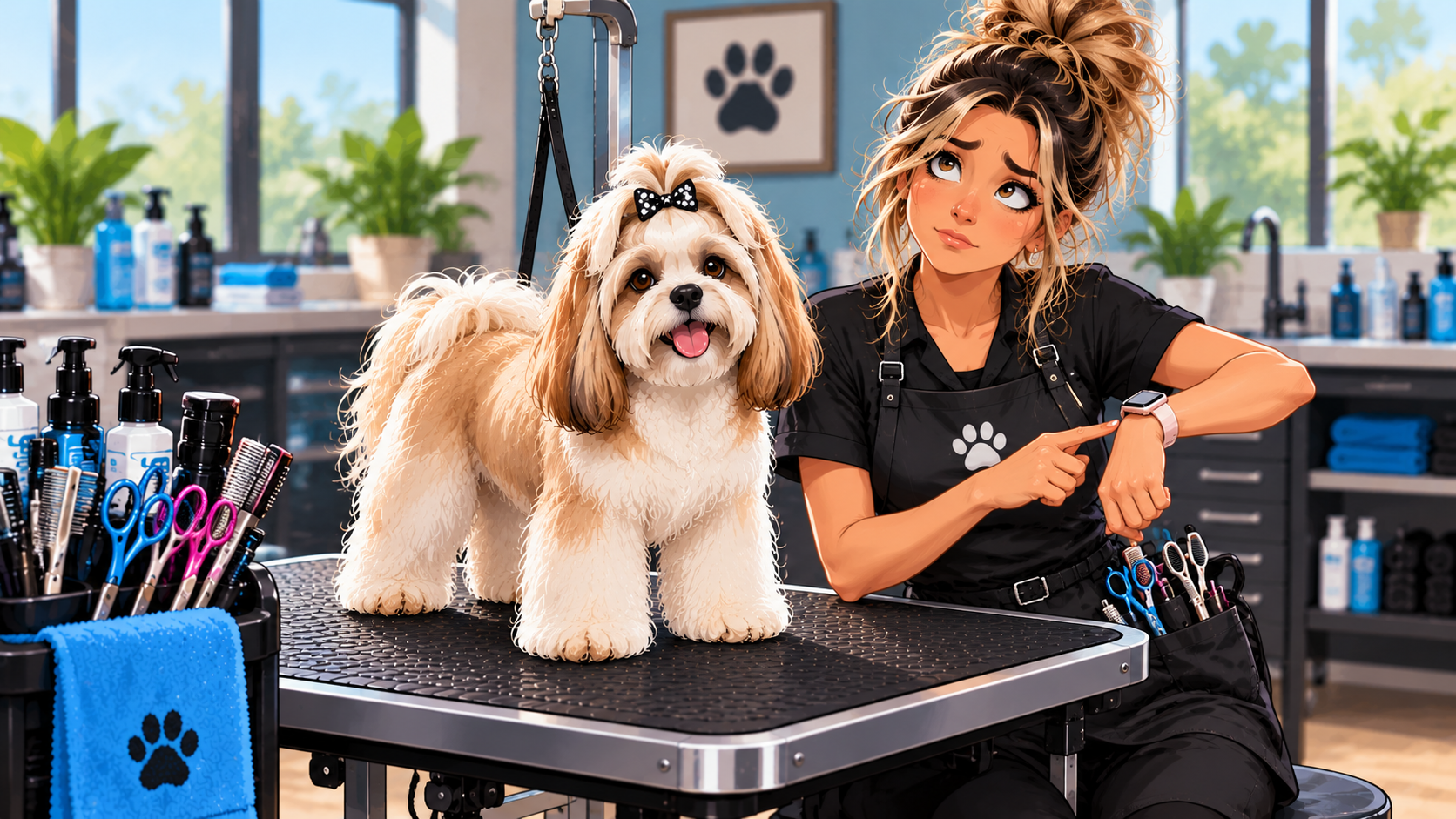
There are also scheduling mishaps when a dog requires more brushing than the usual twenty minutes set aside for a dog in good condition, especially when we were unaware of the problem at the time the appointment was made. You may not even realize there is an issue.
Long and curly coats can look perfectly fluffy on top while having tangles closer to the skin. Double coats can have an enormous amount of impacted undercoat hiding underneath the coat you see. A dog may have gotten wet, worn clothing or harness that caused friction or simply gone through a heavy shed since the last appointment.
If we booked the dog expecting twenty minutes of brushing and discover there’s actually an hour of coat work, that time has to come from somewhere. Sadly, there is no drawer under the grooming table where we keep extra time. Please take a moment to look for one if you find those unicorns and we’ll probably groom your dog for free for life if you find it.
Matting can change not only how long the groom takes but also what haircut can safely be done. Removing a matted coat with clippers is NOT the same thing as clipping through a clean, brushed coat. The groomer has to work carefully around skin that may be pulled tightly into the matting, and the condition underneath may not even be visible until the coat starts coming off. It also deteriorates and damages our expensive equipment that most of us purchase and maintain out of pocket.
What was actually booked matters too. If you booked a bath and the dog arrives needing a full haircut, or the basic pet trim we scheduled turns into extensive de-matting and a heavily hand scissored style at drop off, that is not a little change. We scheduled time for one job and a completely different job just walked through the door that takes 2-3 times longer.
We can sometimes accommodate it. What we cannot do is bend the space time continuum to make it take the amount of time originally booked. Aaaand let’s face it…. Putting your pup through hours of pulling, irritation, discomfort and brushing and combing for cosmetic reasons isn’t what most of us signed up for. Much kinder in most cases to just go under the mats and figure out a haircut schedule and length that prevents your pup from dealing with that discomfort in between grooms again.
Again, faster isn’t necessarily safer.
The Haircut You Want Matters Too
Not all haircuts take the same amount of time.
A short all over pet trim is not the same amount of work as a longer, fluffy, heavily scissored trim. Maintaining breed patterns takes time. Hand scissoring takes time. Blending takes time. Shaping legs, feet and faces takes time.
And the longer the coat you want left, the more important the preparation generally becomes. You cannot leave one inch of beautiful, fluffy coat if you can’t get a metal comb with closely spaced teeth, held flat to the skin, through that one inch of coat. Showing me the picture on your phone again does not make the comb go through. Wrong brush or comb doesn’t make our comb go through. A perfectly maintained back and nothing else does not make our comb go through the legs and chest. 10 minutes a day at home in between grooming does not make our comb go through.
Size and coat length obviously matters too. There is simply more dog. More dog to wash. More dog to rinse. More dog to dry. More coat to brush. More body to clip and considerably more leg to scissor.
That doesn’t mean every big dog takes longer than every little dog, because coat and behavior matter too. But a well behaved 80 pound doodle is still an 80 pound doodle. That is a lot of doodle.
Behavior Can Add A LOT Of Time Without A Dog Being “Bad”
Behavioral difficulties don’t necessarily mean a dog is aggressive or impossible to groom.
Sometimes it’s one thing. Sometimes they are trying to play. Sometimes they simply wiggle a lot. Sometimes they are older and intolerant of the process. The dog may be fantastic until you touch his feet. Another may hate having his face held. Another thinks the dryer is a tornado come to take them to Oz. Another sits down every seventeen seconds while you’re trying to trim his back legs.
Some dogs also desperately want to participate in the grooming process. They need to see the scissors. They need to smell the clippers. They need to lick the exact foot you are trying to trim. If you are working on the back end, they suddenly need to turn around and find out what the heck you are doing back there. I appreciate the supervision, but it’s not helping.
Every time the dog moves into an unsafe position, the groomer has to stop and correct the position before continuing. If a dog keeps pulling a foot away, we can’t just hold the scissors still and wait for the foot to eventually come flying back into them.
Handling the DOG is as much a part of professional grooming as handling the scissors, and working safely with the individual dog in front of us takes however long it takes that day.
Sometimes The Schedule Just Goes To Hell
Even when your dog is perfectly behaved, beautifully maintained and right on time, something earlier in the day may have happened.
A dog we expected to take two hours took three. Someone arrived late. A dog had unexpected behavior problems. A coat was much worse than described when the appointment was booked. Somebody pooped all over themselves after their bath and had to be washed again. The phone is ringing off the hook. Five nail trims arrived at once. A dryer is only working with one switch, the vacuum or clothes washer broke, the city shut the water off for 20 minutes mid bath.
Welcome to working with animals.
One unexpected hour early in the day can ripple through everything scheduled after it. There is no magical reset at noon where we get to start the schedule over. There are also situations where groomers and bathers are checking dogs in, checking dogs out, answering phones, answering questions, booking appointments, doing walk in nail trims, cleaning and sanitizing kennels, tables and equipment between pets, vacuuming and sweeping, cleaning the areas out front everyone likes to potty at, doing laundry and cleaning up general messes in addition to doing the actual bathing and grooming. Depending on the shop, the person grooming your dog may be and is likely to be doing ALL of those things and more.
And yes, sometimes somebody has to stop what they’re doing to help another groomer safely move a huge dog, deal with a loose dog, clean up a spectacular bodily fluid event or handle any of the other things that happen when you put a bunch of dogs in one building.
There are days when the entire schedule runs perfectly.
We don’t trust those rare days.
Calling Every Twenty Minutes Does Not Speed Things Up
If your groomer says they will call you when your dog is ready, please let them.
Every time the groomer has to stop, safely put down their tools, secure the dog and answer the phone to explain that your dog is not finished yet, they are spending time talking about why your dog isn’t finished instead of finishing your dog. And we’re back to rising stress levels for groomer and pup as well.
Believe me, they are already working as fast as they safely can.
If you NEED the dog by a certain time, tell us when you schedule. That gives us the opportunity to tell you whether it’s possible and arrange the schedule appropriately.
Telling us when you drop off is considerably less useful because the day has already been booked around everybody else’s appointments. Sometimes we can make it work. Sometimes we can’t.
Also, unless your groomer specifically tells you to come in, showing up before the dog is finished can be an excellent way to turn a perfectly cooperative dog into a lunatic. Your dog sees you and, as far as they’re concerned, the grooming appointment is OVER.
Done. Finished. Why is this person still touching me? MY MOM IS RIGHT THERE.
Trying to finish a face while the dog is attempting to launch himself across the salon to get to you is not faster. Neither is it faster if you are hiding behind the corner and peeking.
They know. They see you. They hear you. They smell you. They REACT to your presence and it’s very rarely faster.
So How Long SHOULD Grooming Take?
There is no single correct answer.
Breed, size, coat type, coat condition, haircut, behavior, age, drying time, grooming technique, staffing, scheduling and whatever fresh nonsense occurred in the salon that day can all change the answer.
Your dog may normally take two hours and take three today. That doesn’t automatically mean somebody screwed around for an hour. Sometimes grooming simply took longer today. Sometimes your groomer knows exactly why. Sometimes we’re standing there looking at the clock thinking, “How the heck is it already three?”
The Bottom Line
Groomers use various sharp tools and pieces of equipment. Dogs don’t understand when we try to explain what could happen. They just know they don’t like it.
That’s why time can’t be the only consideration.
We have to account for the dog standing in front of us, the condition of the coat, what the dog will tolerate that day, what haircut you requested and what is happening in the shop around us.
Sometimes everything goes perfectly and your dog is finished early. Sometimes every dog in the building apparently got together before opening and decided today was the day to test us.
If your groomer tells you it’s going to take a little longer, give them the time to do their job safely. Nobody wants your dog sitting at the grooming shop all day. Including your groomer. We would also like to go home with another low stress, loved what we did today, injury free day under our belt.
Recent Posts