Things Your Groomer Wishes You Knew: Episode 2
Things Your Groomer Wishes You Knew: Episode 2
Welcome back to Things Your Groomer Wishes You Knew, the series where we explain some of the things groomers know from years of standing at a grooming table that pet owners have probably never had a reason to know.
That's actually an important distinction. We don't expect you to know how to groom your dog. If you did, you probably wouldn't be paying us to do it while you spend several blissful hours pretending your dog doesn't follow you into the bathroom.
What we do need is for you to tell us what you know about your dog, what you want, what you're worried about and what has happened before. Then we take all of that information, add what we know about grooming, our own personal skillset, experience and preferences, and the dog standing in front of us, and figure out the best and safest way to proceed.
In other words, you don't need to become a groomer before your grooming appointment. We already have one of those.
The Consultation Is Actually Important
The grooming consultation isn't simply where you place your haircut order and we send it to the kitchen. It's where we figure out what you want, what your dog needs, how things work in reality and whether those things are currently on speaking terms.
Tell us what you want your dog to look like. Short, medium, long, fluffy, short but not showing skin, one length all over, longer legs, shorter ears, beard left long enough to maintain his distinguished gentleman status. All of those descriptions are useful. Tell us what you loved about the last haircut and what drove you crazy. Tell us that the ears spend more time in the water bowl than they do on the dog.
Plain English is perfectly fine. Actually, it's often MUCH better.
You don't need to memorize blade numbers or guard comb lengths before you come in. If you're trying to describe length, telling us approximately how much coat you'd like left is usually more helpful than telling us how much to take off. "Take an inch off" depends entirely on how much hair is there to begin with. "I'd like about half an inch left" gives us a much clearer idea of the dog you're hoping to pick up and whether it's realistic.
Pictures are helpful too, IF they are of YOUR pup or one similar enough in coat type and anatomy to accomplish the goal. They show us what catches your eye. Maybe it's the round face, the fluffy legs, the short body or the ears. What they don't do is temporarily transform your dog into the dog in the picture. Behavior, tools, time, coat texture, density, structure, condition, skeleton and the amount of hair currently attached to your dog still get a vote.
Bring the picture. We aren't going to laugh at you. We may have to explain which parts will work on your dog and which parts require borrowing somebody else's dog, but now we know what you like.
That's what a consultation is for.
Tell Us the Problem. Let Us Figure Out the Solution.
This is one of those things owners do with the absolute best intentions and groomers see all the time.
Something happened during a previous groom. Maybe your dog came home irritated. Maybe there was a scrape. Maybe his skin was red. Maybe he seemed sore somewhere. Naturally, you don't want it to happen again.
Please tell us.
Seriously. We want to know.
Where things sometimes go sideways is what happens between that groom and the next appointment. You think about it. You Google it. You ask Bing. You read Reddit. You ask Facebook. Your neighbor's cousin has a doodle and apparently has thoughts.
By the time you get to the next groomer, "This happened last time" has somehow become a very specific set of instructions about which tools we are allowed to use and exactly how we're supposed to use them.
We get it. You're trying to protect your dog.
But you can skip the part where you have to solve the grooming problem yourself.
Tell us what happened and ask us what we think. That's not giving up control of your dog's care. That's consulting the person you brought your dog to because they know how to groom dogs.
You know things about your dog that we absolutely need to know. We know things about grooming that you shouldn't have to know. Put those two things together and we can usually come up with a much better plan than either of us could with half the information.
Every Groom Is Its Own Experience
There is no universal set of instructions that works for every dog, every haircut and every appointment. Even the same dog doesn't necessarily need exactly the same approach every time.
Every groom is its own experience with its own needs.
Coats change. Skin changes. Dogs age. Hair grows differently. Behavior changes. Health changes. A dog who stood like a tiny professional show dog six months ago may arrive today having decided that feet are private property and we will be hearing from his attorney.
We work with the dog who showed up today.
That's a much bigger part of professional grooming than simply knowing how to operate clippers and scissors. Our training and experience teach us how to look at the individual dog, the coat, skin, anatomy, behavior, condition and desired haircut and decide how to safely get from Point A to Point B.
Sometimes the answer changes.
A technique that works beautifully for one dog may be completely inappropriate for another. Something that worked for your dog last year may not be the best choice now. There may be three perfectly legitimate ways to accomplish the same basic result, and the groomer needs to decide which one makes sense for the animal currently standing on the table.
That decision-making is a lot of the skill you're paying for.
We aren't trained to blindly perform a collection of menu items. We're trained to groom the individual dog in front of us.
One or Two Times Does Not Mean Every Time
This is another really common leap, and it makes sense when you think about it from the owner's side.
Something happened once. Maybe twice. You don't want a third time, so you identify what seems to be the common denominator and eliminate it.
Except sometimes the thing you've identified isn't actually the cause.
If your dog was irritated after a sanitary trim once or twice with another groomer, that is important information. It does not automatically mean your dog gets irritated every time a sanitary is clipped. It doesn't mean clippers themselves are the problem. It doesn't mean every groomer is going to produce the same result.
It means your dog was irritated after those particular grooms.
Tell us exactly that. If it's a few times out of 20, the method was PROBABLY not the cause of the irritation. Just a mention is needed, not an instruction on how you think we should prevent it.
There are a ridiculous number of variables involved. Different groomer. Different equipment. Different technique. Different products. Different pressure. Different length. Different preparation. Different dog handling. Possibly a different condition of the skin. Definitely a different day in the life of a dog who has never once checked our appointment notes before deciding how he plans to behave.
One or two experiences with someone else shouldn't automatically become a permanent grooming rule.
"My dog was irritated after his sanitary the last two times" gives us information we can use.
"You can't use clippers on his sanitary because clippers burn him" gives us the conclusion you reached from that information.
Give us the first one. We'll help you with the second because the second is likely the incorrect and least safe option.
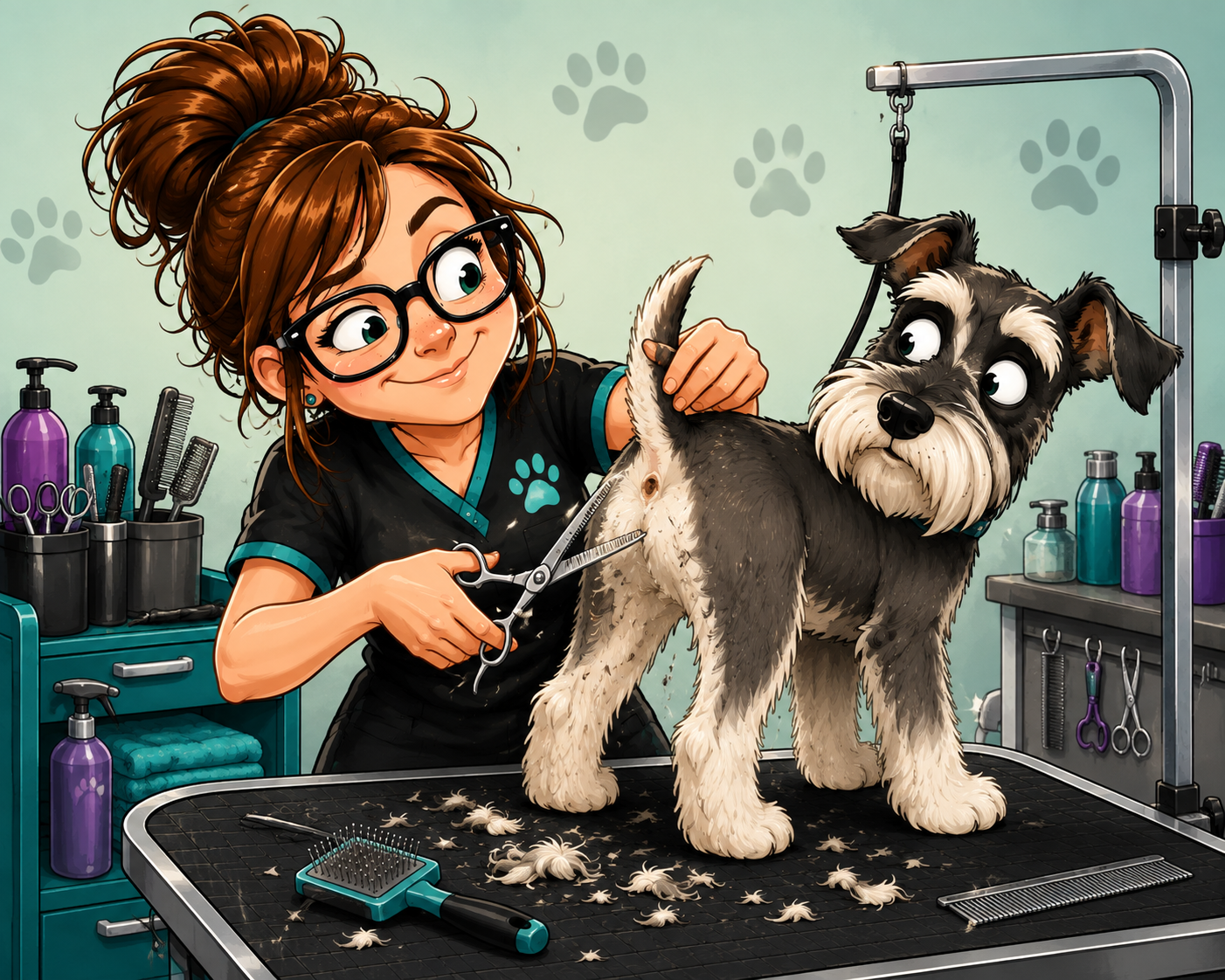
About That "Just Scissor the Sanitary" Instruction...
This one comes up often enough that groomers everywhere just nodded.
A dog has been irritated, scraped or clipper burned during a sanitary trim, sometimes once and sometimes a couple of times, and the next groomer is told, "Don't use clippers. Just scissor it."
It sounds logical. Clippers caused a problem, so don't use clippers.
Except we don't actually know that the fact that clippers were used was the problem, and scissoring the sanitary is most definitely NOT safer than properly clipping it.
Sanitary areas have thin, loose, delicate skin surrounding some fairly important anatomy. Scissors have exposed cutting edges. Dogs move.
I feel like we can all look at those three facts together and see where this is going.
That doesn't mean we don't care that your dog was irritated before. We absolutely care. That's why we need you to tell us. Maybe your dog's skin is particularly sensitive. Maybe the area was clipped too closely. Maybe the groomer just had their equipment sharpened. Maybe their equipment needed to be sharpened. Maybe they need a new blade drive. Maybe they were dealing with carpal tunnel, a fever, or elbow or shoulder pain while attempting to groom that day. Maybe a dog just broke their other 10 blade when it got kicked to the floor. Maybe they were overwhelmed with the pressure and the blade got too hot. Maybe they just tried a little too hard to get it right. Maybe the dog thought they were trying to neuter them again. Maybe the technique needs to change. Maybe the dog's anatomy requires a different approach. Maybe there is another factor entirely.
That's exactly the kind of decision a groomer is trained to make.
The solution to one groomer having a problem once or twice isn't to instruct every groomer afterward to use a less safe method. The solution is to tell the next groomer what happened and let that groomer decide how to avoid it AS IT COMES UP.
"He was irritated after his sanitary the last two times. What do you recommend?"
Perfect.
Now we're having a consultation.
Google Has Never Groomed Your Dog
I am absolutely not going to tell you not to research things about your dog. You should. There is a lot of useful information out there, and being interested enough to learn about your dog's care is generally a good thing.
There is also some spectacular nonsense out there.
More importantly, even perfectly accurate information may not apply to the dog standing in front of us today.
Google can't feel your dog's coat. Bing can't find the mat hidden behind his ear. Reddit can't see his skin. Facebook doesn't know that he becomes a boneless noodle the instant anyone picks up his front foot.
The person grooming him can.
So if you read something that concerns you, ask us about it. If somebody told you something about grooming that sounds important, bring it up. If you want to know why we're recommending something different from what you read, ask.
A good consultation isn't you silently accepting whatever the groomer says, and it isn't you arriving with a grooming procedure you assembled from six search results and a Reddit thread.
It's a conversation.
You tell us what you know about your dog. We tell you what we know about grooming. We look at the actual dog involved and make a plan from there.
You don't need to study for your grooming appointment.
You Know Your Dog. We Know Grooming.
You know what happens during the six or eight weeks when we don't have your dog. You know whether he swims every weekend, lives in sweaters, hates having his back feet touched, scratches after baths, rolls in everything he can find or has recently developed a strange little bump behind his shoulder.
You know whether something happened after the last groom that we couldn't possibly know about unless you tell us.
We need that information.
Your groomer knows coat, skin, grooming equipment, handling, preparation, techniques, haircut construction and the thousand tiny decisions that happen DURING a groom that nobody really notices unless something goes wrong. You need that information too. That's why this works best when neither person tries to do both jobs.
Tell us what you want. Tell us what happened. Tell us what worries you. Ask questions. Bring up what you read online if you want to discuss it.
Then let us look at your dog and do what we're trained to do, and allow for the fact that the plan MAY have to change as the groom is happening because your pup has a say too. You don't have to walk into the salon already knowing the solution.
Honestly, that's one less thing you have to Google.
Please Be Honest About What Happens at Home
At some point during a consultation, especially if you want to keep your dog longer, your groomer is probably going to ask about brushing.
This is not a test.
There is no correct answer we're waiting for, and you don't get extra credit for saying "every day." We need to know what actually happens at home because the amount of maintenance you're realistically willing and able to do has a lot to do with what haircut is going to work for you and, more importantly, your fur kid.
If you brush every day, fantastic. If you brush twice a week, tell us. If you own a brush and occasionally look at it with good intentions, we can work with that information too. If you THINK you brush (this is actually the most common), we can work with that too.
Maybe you hate brushing. Maybe your dog hates brushing. Maybe you have kids, work, dinner, laundry and approximately 400 other things you'd rather do at the end of the day than line-brush a doodle. That's okay. You aren't applying for a grooming license.
What doesn't work particularly well is choosing a haircut that requires twenty minutes or more of maintenance every day when both you and your dog have already agreed that neither of you intends to participate.
Tell us the truth and we can help you choose something that fits your actual life.
Also... We Know
This seems like a good time to let you in on a little secret.
We know when you THINK you're brushing and combing properly but aren't. We know when you aren't brushing the ENTIRE dog. We know when you haven't brushed your dog for months or at all since your last groom. We know when you bathe your dog and don't brush or dry properly. We know when your pup wears sweaters or harnesses without them being taken off and the areas brushed out. We know when your metal comb isn't anywhere near the part you actually need to be combing. We know when you haven't taken out and replaced those bows or tie-ups properly, which NEEDS to happen if you ask for them. We know when things change.
And we know that didn't just take a week or two, or a month.
We're not psychic about everything. We'll get to the things we definitely cannot see through hair later. But coat maintenance leaves evidence, and when you've spent years putting your hands through thousands of coats, you learn to recognize it and even the types and patterns of matting.
Surface brushing feels different from a coat that has been brushed all the way through. Friction from a harness or sweater tends to show up in predictable places. A dog who has been bathed and allowed to air dry with tangles in the coat presents differently from a dog whose coat has simply gone too long between brushing sessions. A dog whose back gets brushed every night while the armpits, chest and legs have apparently been placed in witness protection usually makes that pretty obvious too.
This isn't a courtroom. You don't need a defense.
If we ask what happened, we're usually trying to figure out how the coat got into its current condition so we can help keep it from happening again.
There is a surprisingly large difference between "I brush him every day" and "I brush his back every day, but I didn't realize I needed to get underneath him too." The second answer actually gives us something useful to work with.
Nobody is getting grounded.
Brushing the Dog Includes the Entire Dog
This sounds painfully obvious until you start grooming professionally and realize how many beautifully brushed backs are attached to completely forgotten armpits, legs, chests and under ears.
Most people naturally brush the parts that are easiest to reach. The back gets brushed. The sides get brushed. The top of the head gets brushed. Maybe the tail gets a few passes if everyone is feeling ambitious.
Meanwhile, behind the ears, underneath the collar, the chest, armpits, belly, inside of the legs, feet and all the other places where hair rubs against hair quietly begin forming their own little communities. Also, it's those mats that will determine the appropriate and kindest length of your next haircut, not the brushed-out parts. Those are also some of the places most likely to mat because they move and experience friction constantly. Add a harness, sweater or jacket and you have even more friction. Add moisture and things can get interesting surprisingly quickly.
This is why groomers sometimes seem confused when we're told a dog is brushed every day while we're standing there feeling matting underneath the coat. We aren't necessarily accusing you of lying. You probably ARE brushing every day.
You may just be brushing the same 60 percent of the dog every day.
That's fixable.
Ask us to show you what you're missing. We can point out the areas where your particular dog tends to tangle and show you an easier way to reach them. We'd much rather do that now than shave those areas six weeks from now while you stare at us wondering where all the hair went.
The Brush Is Only Half the Story
Depending on the coat you're maintaining, brushing may not be enough. This is where the comb comes in.
A brush can make the surface look beautiful while leaving tangles closer to the skin. The comb is the reality check. If an appropriate grooming comb can move through the coat from the skin outward without getting stuck, you're in pretty good shape. If it stops halfway down the hair, the fact that the top three inches look magnificent isn't going to help us much.
This is one of those things that's much easier to demonstrate than explain. If you're not sure whether you're brushing correctly, bring your brush and comb to the appointment or ask your groomer to show you.
Really.
You are not going to be the first person who didn't know. Dogs do not arrive with coat-maintenance manuals, and somehow a lot of them come with enough hair to require one.
We can show you what tools make sense for your dog's coat, where your trouble areas are and how to check your work without turning your living room into a second grooming salon.
Dog Haircuts Require Home Maintenance Between Grooming Appointments
There is no universal "easy" haircut. Maintenance depends on coat type, texture, density, length, lifestyle and how frequently the dog is professionally groomed. But generally, if you want more hair left on the dog, somebody has to maintain more hair. That somebody is you for most of the time between appointments. It is not up to your groomer to make up all those days of brushing in a few hours, and many CAN'T do so safely and humanely even if you're willing to pay those top-dollar dematting fees that aren't included in your base price.
This isn't punishment for wanting a fluffy dog. We like fluffy dogs too. We make an alarming percentage of our living making dogs fluffy. But there is a practical relationship between how much coat you want, how much maintenance you're willing to do, what your pup and their skin tolerate and how long you want to go between grooming appointments. If you love a long fluffy haircut and enjoy brushing, wonderful. We can make a plan around that. If you love a long fluffy haircut but your dog reacts to the sight of a brush as though you've arrived carrying a chainsaw, we need to talk. If you love a long fluffy haircut, hate brushing and want to come in every three months, we're going to have an even more interesting conversation.
None of those things makes you a bad pet owner. It just means we need to find the haircut that works for the dog, lifestyle, time and human combination we're actually dealing with. A slightly shorter haircut that stays comfortable and looks good between appointments is a much better choice than a gorgeous long haircut that everybody regrets four weeks later when the pup looks like a naked mole rat after the next groom and has had to live with the uncomfortable tangles in between.
Your Dog's Lifestyle Affects Coat and Haircut Maintenance
Home maintenance isn't the only thing affecting the coat between appointments, so tell us what your dog actually does. Does your dog swim? Hike? Camp? Roll in grass? Dig in the yard? Go to daycare? Wrestle another dog for three hours every afternoon? Wear a harness all day? Spend the winter in sweaters? Have an apparently sacred obligation to locate every puddle within a five-mile radius? Those things matter.
A long coat on a dog who spends most of the day lounging around the house is not the same maintenance project as that same coat on a dog who swims every weekend and considers shrubbery a recreational activity. Water, friction, dirt, debris, clothing and activity all affect how quickly coat tangles. Your groomer isn't asking about your lifestyle because we're nosy. We're trying to figure out whether the haircut you want is going to survive your dog's actual life.
Sometimes your priorities are completely reasonable even when they aren't practical. Maybe you know the longer coat is more work but you love it and you're willing to do the work. Great. Maybe your dog sleeps pressed against you every night and therefore must remain fluffy because that is clearly more important than several other considerations. Also fair. We can discuss your options. The important thing is that we're all working with the same and accurate information.
How Often Should Your Dog Go to the Groomer?
How often your dog comes to the groomer matters just as much as what happens at home. A haircut that works beautifully on a dog coming every four weeks may be completely unrealistic for the same dog coming every ten or twelve weeks. There is simply more time for the coat to grow, tangle, collect debris, experience friction and generally make its own decisions. When your groomer recommends a schedule, it isn't necessarily because we're trying to fill the calendar with your dog's name. We have plenty of dogs.
We're recommending it because we've seen what your dog's coat looks like at four weeks, six weeks, eight weeks or twelve weeks, and we're trying to match the schedule to the haircut you want and the amount of maintenance happening between visits. If you want to stretch the time between appointments, that's another thing you can simply tell us. We may recommend going shorter so the haircut lasts better and remains manageable longer. Again, there isn't a morally correct grooming schedule. There is only a schedule that works or doesn't work for the haircut, coat, dog and home involved.
Haircuts Depend on the Coat That Arrives
This one can be disappointing, and groomers genuinely understand why. You had a haircut in mind. Maybe you've been growing the coat for months. Maybe you finally got the ears exactly where you wanted them. Maybe you have a photo saved on your phone and you've been waiting for the dog to have enough hair to do it. Then we put our hands through the coat and find matting.
At that point, what everybody wanted when the appointment was booked may no longer be possible. Groomers cannot create a haircut out of coat that isn't safely available to use. If the hair needed for the style is severely tangled or matted, the condition of the coat has now become part of the haircut decision. This isn't us refusing to do what you asked because we don't like the haircut, we're lazy or it's too much work. We like hair. Hair is kind of the whole business model. But we also have to consider what getting from the coat we have to the haircut you want would require the dog to endure. Sometimes the answer is reasonable brushing and detangling. Sometimes it isn't.
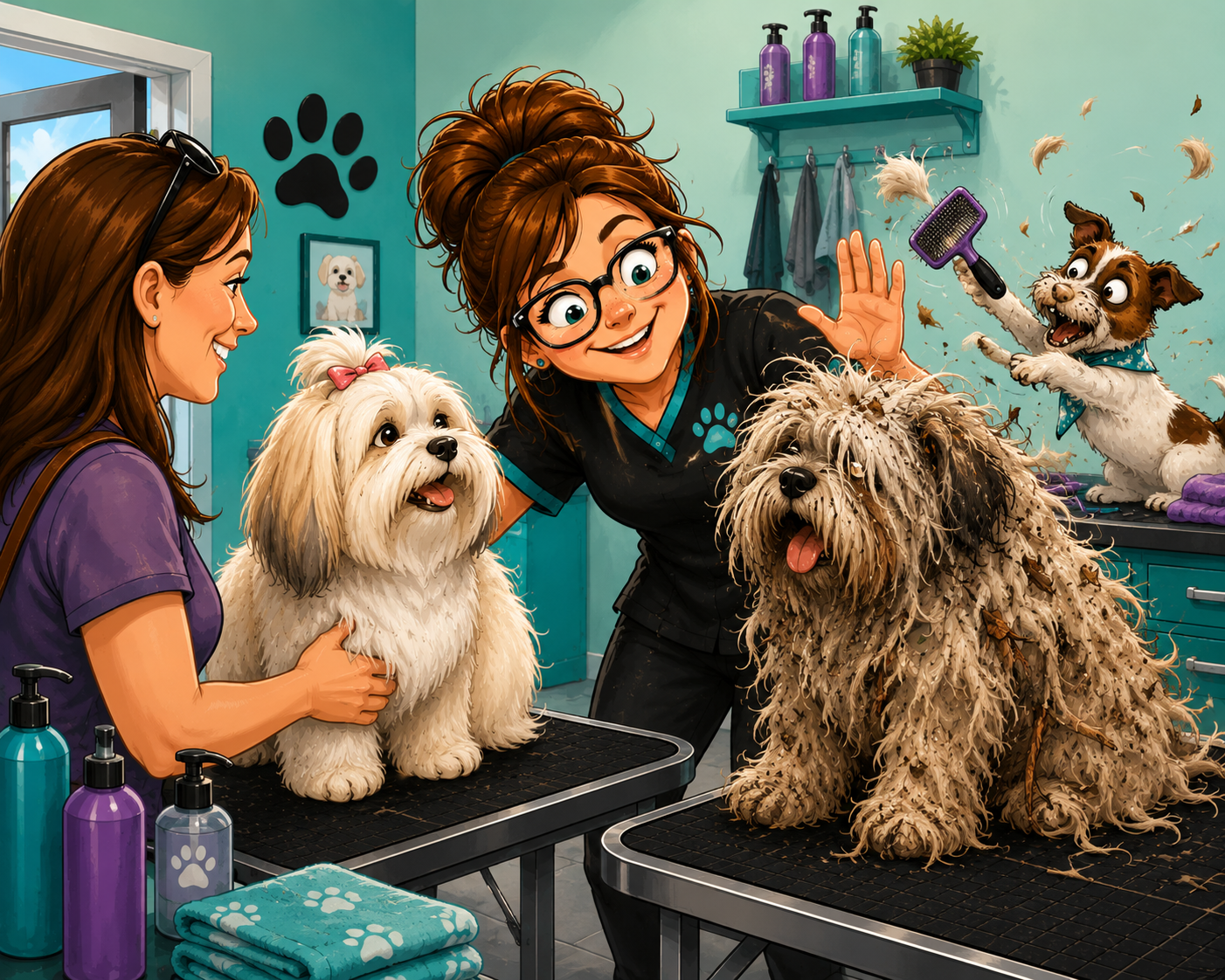
Dematting a Dog Has Limits
A normal grooming appointment can include dealing with reasonable tangles. Dogs are dogs. Hair tangles. Nobody is sounding an alarm because we found a knot behind an ear.
Extensive matting is different. Dematting takes time and even skill that all groomers vary at, but time isn't actually the biggest issue. The bigger issue is the dog underneath the mats. Pulling apart tightly tangled coat pulls on skin. Repeated brushing over the same area can irritate it. Severe matting can already have the skin underneath it under constant tension before we even begin. At some point, preserving the hair stops being worth what we would have to put the dog through to save it.
There is no magical professional-only brush hidden in the back room that makes severe matting gently fall apart while the dog eats snacks and listens to spa music.
We wish.
Sometimes the safest and kindest thing to do is clip underneath the matting, take the coat shorter and start again. That can be disappointing. We know you may not like how short the dog has to be. We probably don't love taking off the coat you spent months growing either. But the dog doesn't care how many months we spent growing the hair. The dog cares about what we're doing to their skin right now.
Why Your Groomer May Need to Shave Your Dog Shorter
This may be one of the biggest misconceptions surrounding matted dogs.
When a groomer says the dog needs to go shorter, we aren't punishing you because you didn't brush enough. We aren't teaching you a lesson. We aren't angry at your dog, and we don't have a secret salon competition to see who can send home the baldest doodle. We're making a grooming decision based on the condition of the coat and the comfort of the dog.
Sometimes owners are embarrassed when their dog is matted. You really don't need to be. Groomers see matting constantly, and there are plenty of reasons it happens. Coat changes, illness, family emergencies, a busy month, an owner who didn't realize their brushing wasn't reaching the skin, a dog who stopped tolerating brushing, sweaters, swimming or simply a haircut that required more maintenance than anyone realized.
Tell us what happened if you know.
Then let's figure out what works better next time.
Maybe that's better brushing technique. Maybe it's a different tool. Maybe it's a shorter haircut. Maybe it's coming in two weeks earlier. Maybe it's accepting that your dog is destined to live a perfectly happy life looking adorable in half an inch of hair instead of three inches. The goal isn't to win at having the longest coat. The goal is a clean, comfortable dog in a haircut that works for the life the two of you actually live.
Groomers Cannot See Moles and Skin Growths Through Hair
There are a lot of things groomers learn to find with their hands. Mats, skin changes, lumps and bumps have a way of introducing themselves eventually when you spend all day bathing, drying, brushing and clipping dogs. Unfortunately, we still haven't developed X-ray vision. Moles, skin tags, warts, cysts and other little growths can be completely hidden underneath a dog's coat. Sometimes the owner doesn't know they're there. Sometimes we don't know they're there. Sometimes nobody knows they're there until the hair covering them is removed. This is especially common with older dogs, who seem to reach a certain age and begin collecting random bumps like souvenirs.
If you know your dog has a mole or growth, please point it out during the consultation. Don't assume we'll automatically find it before we get to it. If it's buried underneath any coat, there may be absolutely nothing visible from the outside telling us it's there. If we know about it, we can try to work around it. If neither of us knows about it, we're both about to meet it at the same time.
Why a Slightly Longer Dog Haircut Can Be Safer
Hidden growths are one of the reasons a groomer may recommend leaving a little more hair than you originally requested. A comb attachment leaves more clearance between our blades and the skin and any moles, warts or growths that may be there. On a dog with known bumps and growths, or a dog whose age and skin make us suspect there may be a few surprises hiding underneath the coat, leaving the haircut slightly longer can give us a better chance of staying above them. Sometimes the difference isn't dramatic. You may ask for a very short haircut and your groomer may recommend going just a little longer with a comb instead. We're not trying to ruin your haircut. We're trying to send the dog home with all of the same pieces they arrived with. If you happen to nay-say this suggestion, please don't expect your groomer to miss moles with that 7 or 10 blade because it just is less likely, and they offered.
You are still allowed to prefer the shorter haircut. We can explain what we're concerned about and recommend the safer option, but ultimately there are grooming decisions where an informed owner may decide they still want something different. What isn't reasonable is declining the safer recommendation and then expecting the groomer to somehow eliminate the additional risk that came with that decision. If I tell you I would prefer to stay slightly longer because your dog has bumps hidden throughout the coat and you still want the shorter haircut, I will be as careful as I can possibly be. But careful still does not mean psychic or that I will be able to groom in some magical way to avoid moles and growths.
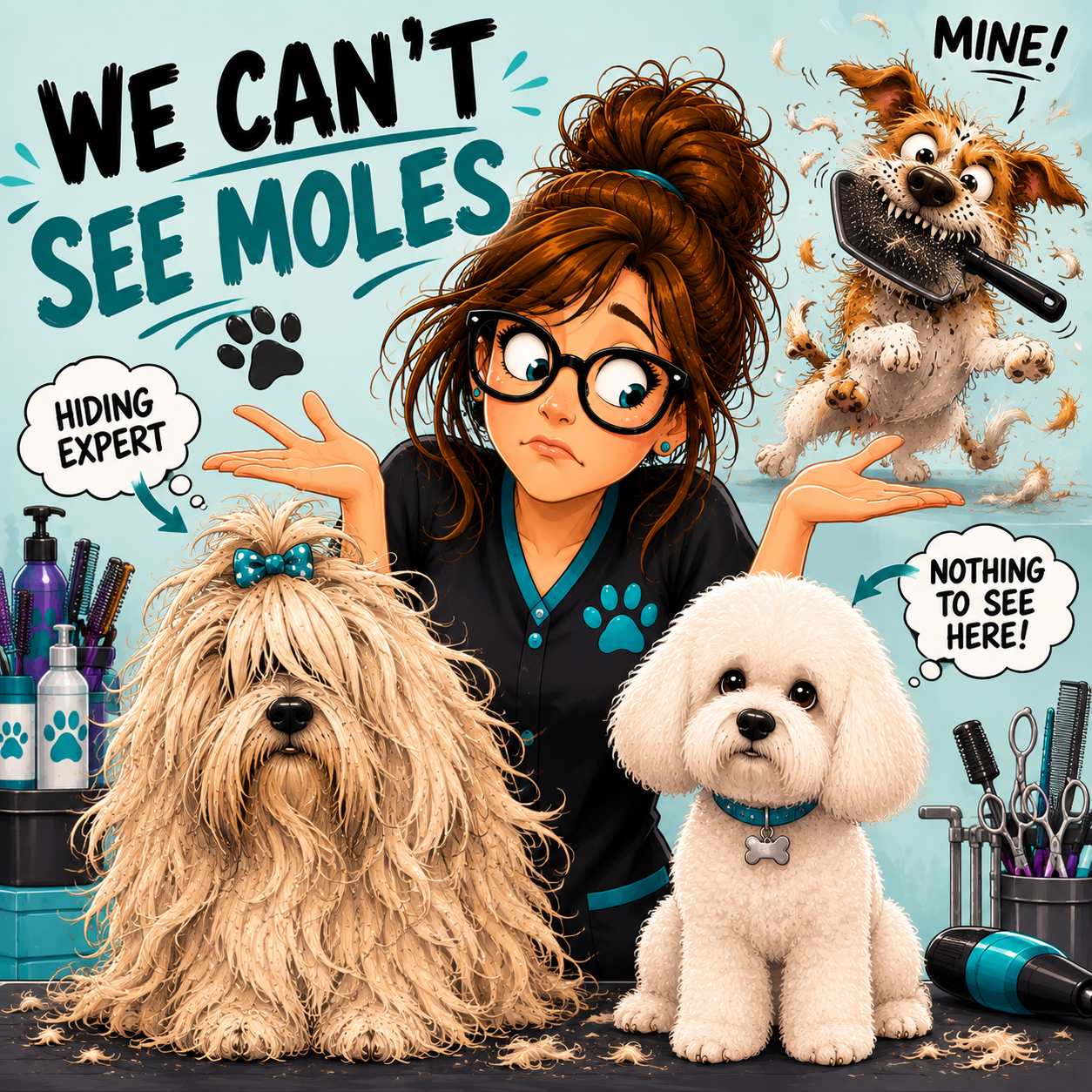
WE CAN'T SEE MOLES
This one really shouldn't require much explanation, but apparently it does: WE CAN'T SEE MOLES.
Not through hair.
When we're clipping a dog, the clipper is removing the coat that is preventing us from seeing the skin underneath it. We don't get to look at the bare skin first, locate every mole, skin tag, wart or little growth, mark them all on a map and then put the hair back before we start grooming. We see that section of skin after the hair covering it has been removed. If there's a mole hiding underneath that hair, the clipper may encounter it before we ever have the opportunity to know it's there.
That's not carelessness. That's how clipping a dog works.
Even if you know your dog has moles, and even if you tell us your dog has moles, we still can't see them through the coat. Please tell us anyway because knowing about your dog's skin is useful information, especially if there is a large or unusual growth we should know about. But "my dog has several moles" does not suddenly make those moles visible underneath an overgrown coat.
And no, it isn't realistic to expect a groomer to remember the precise location of every mole from the last haircut either. Dogs move. Skin moves. Skin stretches. Hair grows over everything again. A tiny bump that was obvious on a freshly clipped dog six or eight weeks ago may be completely hidden when that dog comes back covered in hair.
This is why a groomer cannot reasonably be held responsible for avoiding moles during a haircut. Avoiding something requires being able to see where it is before you encounter it. In many cases, we can't. The tool removing the hair is also the tool exposing the skin underneath that hair. Sometimes the first moment we can possibly see a mole is the same moment we've already reached it.
If your dog has a lot of moles or skin growths, your groomer may recommend leaving the coat slightly longer and using a comb attachment. That gives us more clearance from the skin and therefore more clearance from whatever may be hiding on the skin underneath all that hair. It reduces the risk. It allows room between the skin and a blade that using just a blade does not, but it does not give us X-ray vision.
You can absolutely decide that you still want the shorter haircut. It's your dog and we're discussing your options with you. But if your groomer recommends the slightly longer comb cut because your dog has a lot of hidden skin growths and you decline it, you are also choosing the increased risk that comes with working closer to the skin. You can't choose the shorter length and simultaneously expect the groomer to guarantee that equipment working closer to the skin will never encounter something invisible on that skin.
We can be careful.
We cannot be psychic.
Why a Bleeding Mole Doesn't Automatically Mean the Groomer Cut Your Dog
Moles, skin tags and other growths can bleed surprisingly easily, and clippers are not the only thing that can make that happen. A fragile growth can open during brushing or even drying. It can open during bathing. It can bleed from scratching, rubbing or ordinary handling. High-velocity dryer air can move the skin enough to disturb a fragile growth. Sometimes one starts bleeding while the dog happens to be at the grooming salon and nobody actually did anything to it at all.
So if a groomer notices blood coming from a mole during the grooming process, that does not automatically mean, "The groomer cut my dog." All too often, we didn't even know there was a mole there until it started bleeding.
This is another place where timing gets mistaken for cause. The fact that something became visible during grooming does not mean grooming created it, and the fact that something bled during grooming does not prove grooming equipment cut it. We are bathing, drying, brushing, handling and removing hair from the entire dog. Things that have been hiding underneath that coat tend to reveal themselves during that process.
Groomers Often Find Lumps, Bumps and Skin Changes Owners Can't See
Groomers find lumps, bumps, moles, skin tags, scabs and other skin changes owners didn't know about all the time. That doesn't mean you aren't paying attention to your dog. Most people do not regularly part the coat over every square inch of their dog's body and inspect the skin underneath it.
We pretty much do.
Our hands are all over the dog during the bath. We separate the coat while drying. We brush and comb down toward the skin. Then, on dogs receiving haircuts, we remove the coat that may have been hiding the skin entirely. Suddenly there's a bump sitting there that nobody has ever seen before.
"Has this always been here?"
"I HAVE NO IDEA. WHAT IS THAT?"
Well, good news. Now there are two of us who would like to know.
If we find a new or concerning lump or skin change, we'll try to remember to tell you so you can have your veterinarian determine what it is if necessary. What we shouldn't do is confuse discovering something during grooming with causing it during grooming.
Your dog's skin existed before we took the hair off.
We just couldn't see it either.
Quicking a Dog's Nail Does Not Mean It Was Trimmed Incorrectly
Let's get one thing out of the way. Quicking a nail does not mean the nail was trimmed incorrectly. It doesn't mean the groomer was negligent, and it does not mean your dog has been traumatized. Do we want to quick nails? Of course not. We also don't want the dog to poop during the blow dry, knock the shampoo bottle into the tub or sneeze directly into our mouths, but grooming involves living animals and occasionally things happen that were not on anybody's vision board for the day.
Part of the misunderstanding comes from the idea that the quick is the line that determines whether a nail was correctly trimmed. It isn't. The goal of trimming a nail is to properly shorten and shape the nail. As I've explained in my full nail-care article, the proper trim is based on the structure and curve of the nail, not on a rule that says "stop before the quick and wherever you land is now the correct nail length."
Quicks vary. They can be long, short, easy to see in a light nail and completely hidden inside a black one. They don't necessarily sit at exactly the same place in every nail on the same dog, and a dog can have long quicks inside nails that still need to be shortened. And dogs move. That's all important because otherwise we end up with the idea that touching the quick automatically proves the nail was cut too short. It doesn't. A properly trimmed nail can occasionally be quicked.
Every groomer, bather, veterinary technician, veterinarian or other professional who trims enough nails is eventually going to quick them. When you're trimming thousands and thousands of individual nails, occasionally meeting the quick is part of working with actual dog nails instead of diagrams of them. We try not to. Sometimes we do.
A Quicked Nail Is Not a Grooming Emergency
The quick contains blood vessels and nerves, so yes, nicking it can sting a little and it can bleed. Many dogs barely react, and some don't react at all. Others react because a leaf moved outside three counties away and they were already emotionally prepared for drama before we touched the foot. We stop the bleeding and move on.
That moment is not automatically traumatic. There is an enormous difference between a dog experiencing a brief unpleasant sensation and a dog being psychologically traumatized, and we need to stop using those words as though they're interchangeable. In fact, if every human in the room turns a tiny quick into a five-alarm emergency, we may do a much better job teaching the dog that nail trims are terrifying than the quick ever did. Dogs pay attention to our reactions too. Calmly handle the problem and continue with life.
Blood After a Nail Trim Doesn't Necessarily Mean the Groomer Quicked the Nail
A nail can be trimmed very close to the quick without actually exposing it, leaving only a very thin layer of nail over the end. Then the dog leaves the salon, walks across concrete, scratches the ground, runs around the yard, drags a foot or launches himself toward Mom at approximately 700 miles per hour because apparently he has been abandoned at the grooming salon for seventeen years instead of three hours. That tiny remaining layer can wear away and expose the quick later. Now there is blood, but that does not mean the groomer cut into the quick during the nail trim.
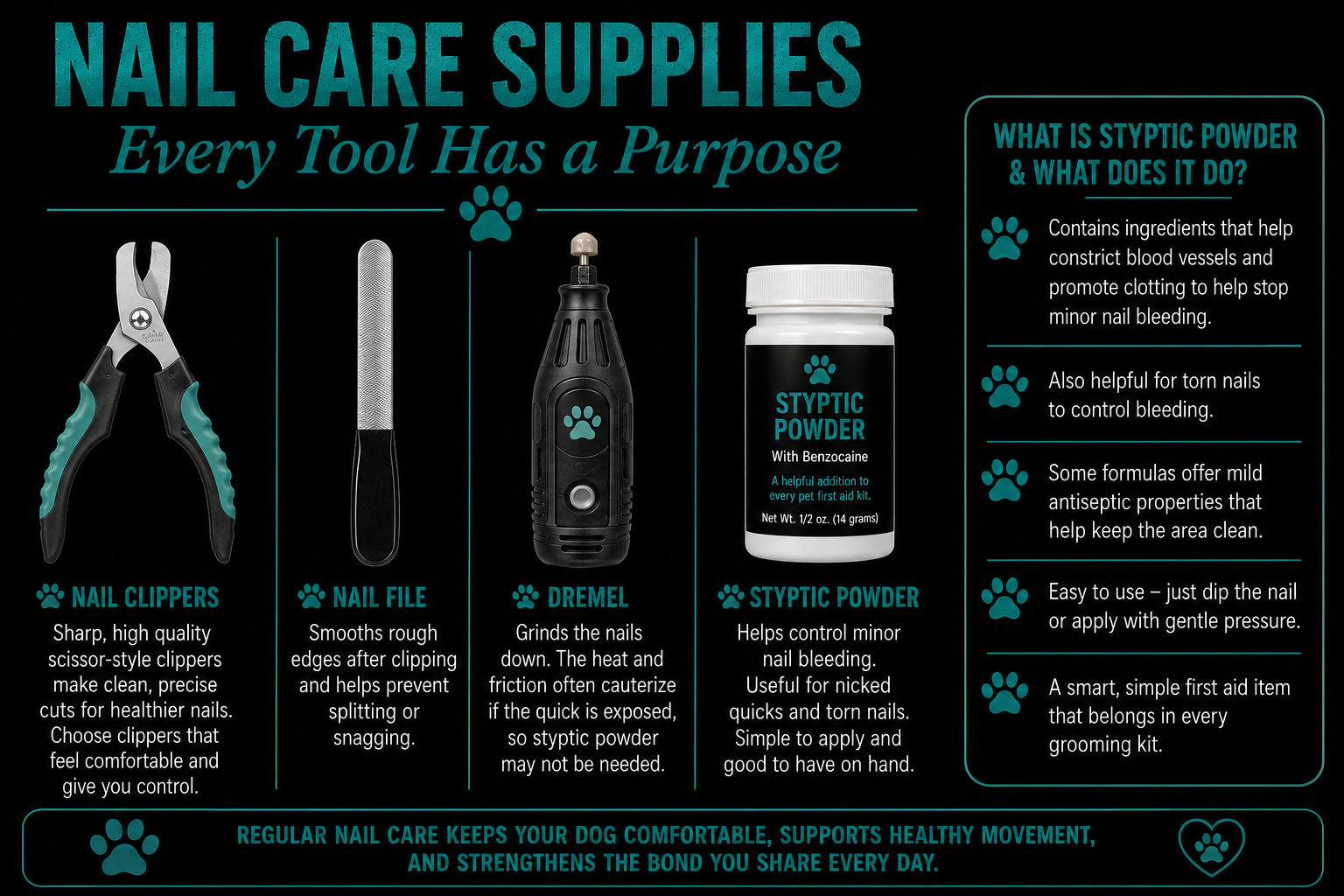
Again, timing and cause are not always the same thing. If you'd like the much longer explanation of nail structure, nail clippers, Dremels, long quicks, bleeding and what actually helps dogs who are afraid of nail trims, I already wrote an entire article about it because apparently I have VERY strong feelings about toenails. For our purposes here, the important point is much simpler. A quicked nail is not proof of a bad nail trim, a tiny amount of blood is not proof of negligence, and your dog having an unpleasant two seconds does not automatically mean your dog has been traumatized. Sometimes a nail is just a nail. And a small note because it's very important: It is not being quicked that causes trauma. It is the fight and the forcing to get it done occurring at the time the pup was quicked.
Your Dog Gets a Vote Too
There are three participants in every grooming appointment: you, your groomer and your dog. Two of us can have a wonderful plan at check-in. The third has not been consulted and may have very strong opinions about it.
Dogs are living, moving, thinking animals. They get tired. They get scared. They get impatient. They have sore spots. They have things they tolerate beautifully and things they have decided are absolutely unacceptable. Some will stand quietly while we scissor every hair on their face and then react to having one front foot touched as though we've violated an international treaty. Others will happily hand us their feet but believe the dryer is trying to kill them. Every dog is different, and every groom has to account for the dog actually participating in it.
This is why the finished groom isn't determined entirely by what you requested at drop-off. We can discuss the haircut, agree on the length and make a plan, but the dog still has to safely allow us to do it. Sometimes that means modifying part of the haircut. Sometimes it means leaving something imperfect. Sometimes it means stopping something entirely. A perfectly symmetrical face isn't worth fighting a frightened dog with scissors beside an eyeball to get it.
Most groomers would much rather hand you a slightly imperfect dog and explain what happened than push a dog past what was safe just so nobody has to admit one ear is a little wonky today. Hair grows. Eyeballs are considerably less convenient to replace.
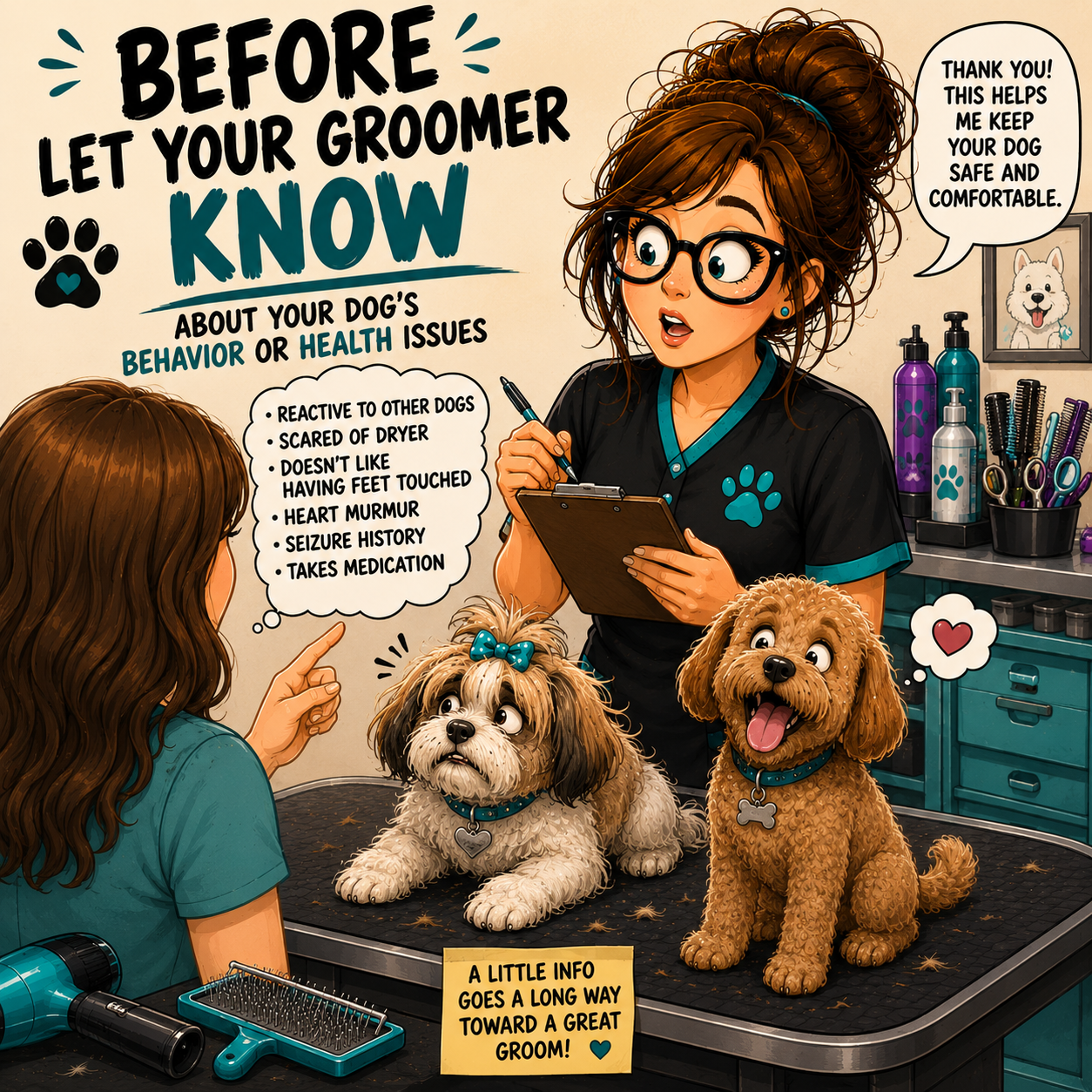
Tell Your Groomer About Your Dog's Behavior
If your dog has bitten a groomer, tried to bite a groomer, panics for nails, cannot tolerate the dryer, screams when a particular leg is touched, has suddenly become sensitive somewhere or has any other handling issue, please tell us.
This isn't a confession.
We aren't sitting behind the counter deciding which dogs have been naughty enough to lose grooming privileges. Behavior is information, and information lets us prepare. If I know your dog is likely to bite when I touch a front foot, I can approach that foot differently. If I know the dryer terrifies him, I can plan around that before I turn it on. If an older dog has suddenly started fighting when his hips are shifted due to picking up a foot, that is information I want before I start moving those hips around.
What isn't helpful is finding out the hard way.
Sometimes owners are afraid that telling us about a bite or difficult behavior means we won't groom the dog. Depending on the severity of the behavior and the individual salon, occasionally it may. But hiding the information doesn't make the behavior disappear. It only removes our ability to prepare for it.
Please don't tell us afterward, "Oh yeah, he did that to the last groomer too."
That would have been excellent information approximately one dog bite ago.
"He Never Does That at Home"
We believe you.
Really.
Your dog probably doesn't stand on a grooming table at home while somebody holds his chin and runs clippers around his feet. You probably aren't using a high-velocity dryer in your kitchen. Most people don't spend Saturday afternoon lifting their dog's tail while trimming hair around his butt with professional grooming equipment.
Home and the grooming salon are completely different environments with completely different expectations.
A dog can be an absolute angel at home and difficult for grooming. A dog can also be a lunatic at home and stand beautifully for the groomer. Neither one means anybody is lying. Dogs respond differently to different people, environments and situations.
They also learn routines. A dog who has been professionally groomed regularly may understand exactly what happens on a grooming table even though he won't let his owner brush one leg at home. Conversely, a dog who happily lets you play with his feet on the couch may have very different feelings when nail clippers appear.
So when we tell you your dog struggled with something, we're not criticizing your dog, we're not accusing you of not knowing him, we're not beating them up, we didn't do anything to cause negativity and it certainly doesn't mean we're bad people.
We're telling you what happened while he was with us.
Your Dog's Grooming Behavior Can Change
The dog we've groomed for five years isn't necessarily going to behave exactly the same way forever.
Puppies grow up. Adults age. Bodies become less flexible. Arthritis and other physical changes can make positions that were once comfortable harder to tolerate. Vision and hearing can change. Skin can become more sensitive. Dogs can develop new fears or simply become less patient about things they tolerated when they were younger.
Sometimes the change is temporary. Maybe your dog doesn't feel quite right today. Maybe he's unusually tired. Maybe something happened before the appointment that we don't know about. Sometimes we never find out why today was different.
We still have to groom today's dog.
If your groomer tells you that something was harder this appointment than it has been before, that isn't necessarily an excuse for an imperfect groom. It's useful information about your dog. If it happens again, now we have a pattern. If it doesn't, maybe he was simply having a bad day.
Dogs are allowed to have those too.
Sometimes "Perfect" Isn't the Safest Grooming Goal
Professional groomers care what their work looks like. We notice details most owners will never see. We see the sticky-out hair on the left cheek. We know one foot isn't quite as round as the other. We know exactly which part of that ear we would love another thirty seconds to fix.
Sometimes the dog says we're done.
There is a point where continuing to chase perfection stops improving the groom and starts unnecessarily testing the dog. A tired senior who has already given us everything he had today doesn't need another ten minutes standing because I can see three hairs on his rear leg that are offending me personally.
A puppy who has successfully tolerated his first face trim does not need to leave with a competition-perfect head. He needs to leave having learned that grooming was something he could handle so we can build on that next time.
A frightened dog who finally lets us safely trim around his eyes doesn't need us to immediately push our luck because we'd really like the muzzle a little rounder.
Good grooming isn't just knowing how to make something perfect.
It's knowing when perfect isn't the most important thing in front of you.
Why Your Dog's Haircut May Be Different From the Last Groom
Owners understandably use previous grooms as a reference. "You did it last time" sounds like pretty convincing evidence that something should be possible again.
Sometimes it is.
Sometimes the circumstances aren't the same.
Maybe the coat was in better condition last time. Maybe the dog came four weeks sooner. Maybe he tolerated his legs better. Maybe there wasn't matting behind the ears. Maybe his skin wasn't irritated. Maybe he's six months older and standing for that long is harder now. Maybe the haircut itself has grown into something different.
This comes back to something I said earlier: every groom is its own experience with its own needs.
We don't ignore what worked before. Grooming history is incredibly useful. But "we did it last time" cannot override what we're looking at today.
The dog in front of us today always wins that argument.
Ask Your Groomer How to Make the Next Groom Easier
One of the strangest things about grooming is how often people apologize before asking us to show them something.
Don't.
If you don't know how to brush a particular area, ask. If you don't know which brush to buy, ask. If you aren't sure whether you're getting all the way through the coat, ask us to show you. If your dog keeps matting in the same place, ask why. If you're struggling with nails at home, tell us what's happening.
We already spend an unreasonable percentage of our lives discussing dog hair. You are not burdening us by asking a dog-hair question.
Most groomers would much rather spend five minutes showing you how to maintain the coat than spend forty-five minutes trying to save it six weeks later.
And if you genuinely don't want to brush?
Tell us that too.
There is no prize for owning the longest haired dog in the neighborhood. We can help you choose something shorter and easier to maintain that's still adorable. A comfortable dog in a cute, practical haircut is considerably better than everybody being miserable because somebody decided one inch of coat was a moral obligation.
You and Your Groomer Are on the Same Team
Most of what groomers wish owners knew really comes down to this: we're trying to work with you, not against you.
Tell us what you want. Tell us what happened before. Tell us what you do at home, including what you DON'T do at home. Tell us about behavior, skin changes, health changes and things you're worried about. Ask questions when you don't understand why we're recommending something.
Then let us bring our part to the conversation too.
We spend years learning this job and then continue learning from every dog we groom. We know what different coats can and cannot do, what different tools do, what various techniques require and when the plan needs to change because the dog, coat or circumstances changed.
You know your dog.
We know grooming.
Your dog knows exactly how much nonsense he intends to tolerate from either one of us today.
Between the three of us, we can usually work something out.
Until Next Time...
Groomers don't expect perfect dogs or perfect owners. If we did, most of us would have been forced into another career years ago.
We need information, realistic expectations and enough trust to make professional decisions about the dog standing in front of us while we work our magic. Sometimes we'll tell you something you didn't know. Sometimes you'll tell us something we couldn't possibly know. Sometimes your dog will immediately invalidate the entire conversation by doing something neither of us has ever seen him do before.
That's grooming.
It's messy, unpredictable, occasionally ridiculous and performed on animals who have never once read the notes from their previous appointment.
And somehow, we still love it.
Wanna Book with Kari or any of her amazing coworkers in North Las vegas? Click Here for more info.
Groomer Confession #2: I have absolutely woken up in the morning, wiped the crusties from my eyes and known whose hair it was I was weirdly pulling out from inside and behind my eyeballs.
Recent Posts